In 2024, SaaS adoption among US businesses continued to climb, with global cloud software spending projected to exceed $100 billion, according to Gartner research. That growth is not slowing down. It is reshaping how companies pick tools, manage workflows, and think about long-term software strategy.
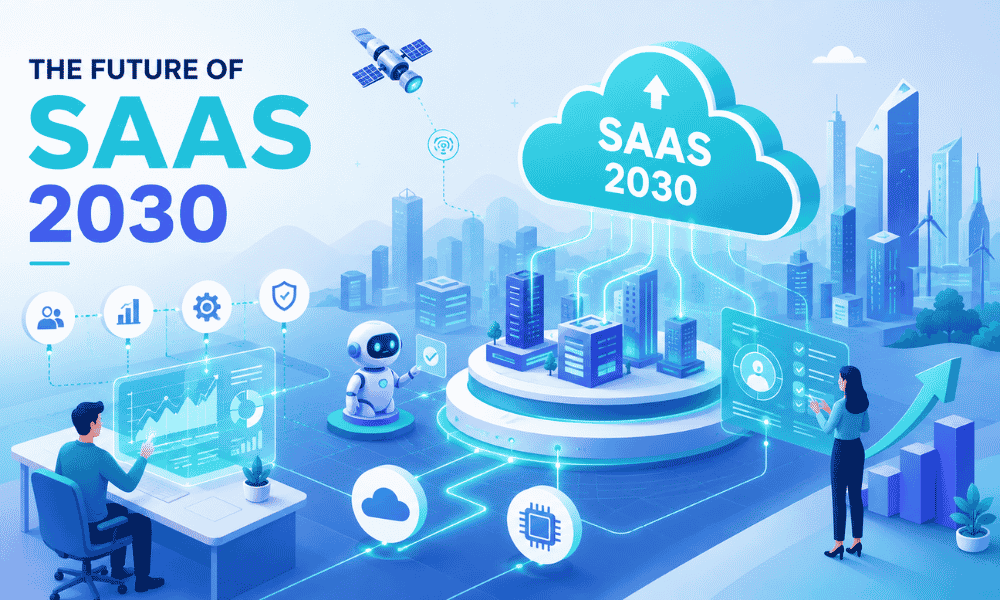
The shift toward the future of SaaS 2030 is not just about more tools in the market. It is about how software behaves inside a business. Instead of static platforms, companies are moving toward systems that learn, adjust, and respond in real time. This changes how teams operate, how decisions are made, and how software budgets are structured.
A McKinsey report notes that over 70 percent of enterprises are already investing in AI-driven platforms. That shift is directly tied to SaaS trends 2030, where automation and intelligence become default expectations instead of premium features. Businesses are no longer asking whether software works. They are asking how fast it adapts.
At the same time, the cloud software future is pushing infrastructure closer to users through edge computing and distributed systems. This reduces delays and improves real-time decision-making for critical business operations.
Looking ahead, the future of SaaS 2030 will not look like traditional software stacks. It will look more like interconnected ecosystems that continuously optimize themselves. The companies that understand this shift early will have a clear operational advantage.
SaaS is moving from tools to intelligent systems
Software used to be a collection of separate tools. One for CRM, one for billing, one for analytics. That model is fading as platforms become more integrated and responsive.
The future of SaaS 2030 is defined by intelligence layered directly into core systems. Instead of manually configuring workflows, businesses will rely on software that learns from behavior patterns and adjusts automatically.
This shift is heavily influenced by AI in SaaS, where machine learning models are embedded into everyday business tools. These systems will not just analyze data but also take action based on it. For example, sales platforms will prioritize leads automatically based on predicted conversion rates, while finance tools will flag anomalies without human input.
As business software 2030 evolves, companies will spend less time managing software and more time interpreting outcomes. The software itself becomes a decision support layer rather than just an operational tool.

The rise of adaptive cloud ecosystems
Cloud infrastructure is no longer just about storage or hosting. It is becoming the foundation for dynamic, distributed systems.
The cloud software future is shifting toward multi-layered environments where applications run closer to users through edge computing. This reduces latency and allows real-time responsiveness, especially for industries like logistics, finance, and healthcare.
Within the future of SaaS 2030, cloud platforms will behave more like ecosystems than isolated products. Businesses will connect multiple services that automatically share data and trigger actions across systems.
This evolution also supports enterprise SaaS tools that operate at scale without requiring heavy manual configuration. Large organizations will rely on unified environments instead of managing dozens of disconnected subscriptions.
Security will also evolve. Instead of perimeter-based models, cloud systems will rely on continuous authentication and behavior-based monitoring. This will become standard in the cloud software future as threats become more automated and complex.
Subscription models will shift toward usage intelligence
The traditional subscription model is already under pressure. Flat monthly pricing is giving way to more flexible usage-based structures.
In the future of SaaS 2030, companies will pay for outcomes rather than access. Software pricing will be tied to actual value delivered, such as processed transactions, resolved tickets, or completed workflows.
This is where subscription software models are changing most visibly. Businesses want predictable costs, but they also want fairness in pricing based on scale and usage. Vendors that fail to adapt will struggle to retain enterprise customers.
At the same time, automation in SaaS is reducing operational overhead for vendors, allowing them to support more customers without increasing headcount. This improves margins while enabling more flexible pricing structures.
The combination of automation and intelligent billing will redefine how software contracts are structured in business software 2030 environments.
AI driven workflows become the default standard
Artificial intelligence is no longer an optional layer in SaaS platforms. It is becoming the foundation.
The AI in SaaS shift is most visible in workflow automation. Tasks that previously required human coordination are now handled automatically. This includes scheduling, reporting, customer segmentation, and even parts of customer support.
As we move toward SaaS trends 2030, AI will not only assist workflows but orchestrate them. Entire business processes will be managed by systems that understand dependencies and execute tasks in sequence without manual oversight.
This also changes how teams are structured. Smaller teams will manage larger outputs because enterprise SaaS tools will handle execution at scale. Human roles will focus more on strategy, oversight, and exception handling rather than repetitive operations.
The future of SaaS 2030 is closely tied to this shift, where software becomes an active participant in business execution rather than a passive tool.

Security, trust, and compliance become embedded layers
As SaaS systems become more intelligent and interconnected, security becomes more complex.
In the evolving cloud software future, security will no longer be a separate layer. It will be embedded directly into every action a system takes. Access control, data usage, and compliance checks will run continuously in the background.
For regulated industries, this is critical. Financial services, healthcare, and government organizations will depend heavily on enterprise SaaS tools that can automatically enforce compliance rules without manual audits.
The future of SaaS 2030 will also bring stronger identity verification systems. Instead of simple logins, platforms will rely on behavioral authentication that tracks usage patterns to detect anomalies in real time.
This reduces risk while allowing faster collaboration across distributed teams.
What businesses should prepare for now
Companies planning for the next five years should not wait for full transformation. The transition is already underway.
The shift toward business software 2030 means evaluating tools not just for current features but for adaptability. Businesses should prioritize platforms that integrate AI, support flexible scaling, and offer modular architecture.
Investing early in systems aligned with SaaS trends 2030 helps reduce future migration costs. Replacing outdated tools later will be more expensive than adopting forward-compatible systems today.
Teams should also rethink how they evaluate vendors in the future of SaaS 2030. Instead of feature lists, they should focus on automation depth, data intelligence, and ecosystem compatibility.
Conclusion
The next phase of SaaS is not about more software. It is about smarter systems that reduce friction and increase speed across every business function. The future of SaaS 2030 is shaping a world where tools think, act, and adapt alongside the companies that use them.
Businesses that understand this shift early will not just save time. They will operate with a structural advantage that compounds over time as systems become more connected and intelligent.
The direction is already clear. Software is moving from passive platforms to active infrastructure. The only question is how quickly businesses are willing to adapt.