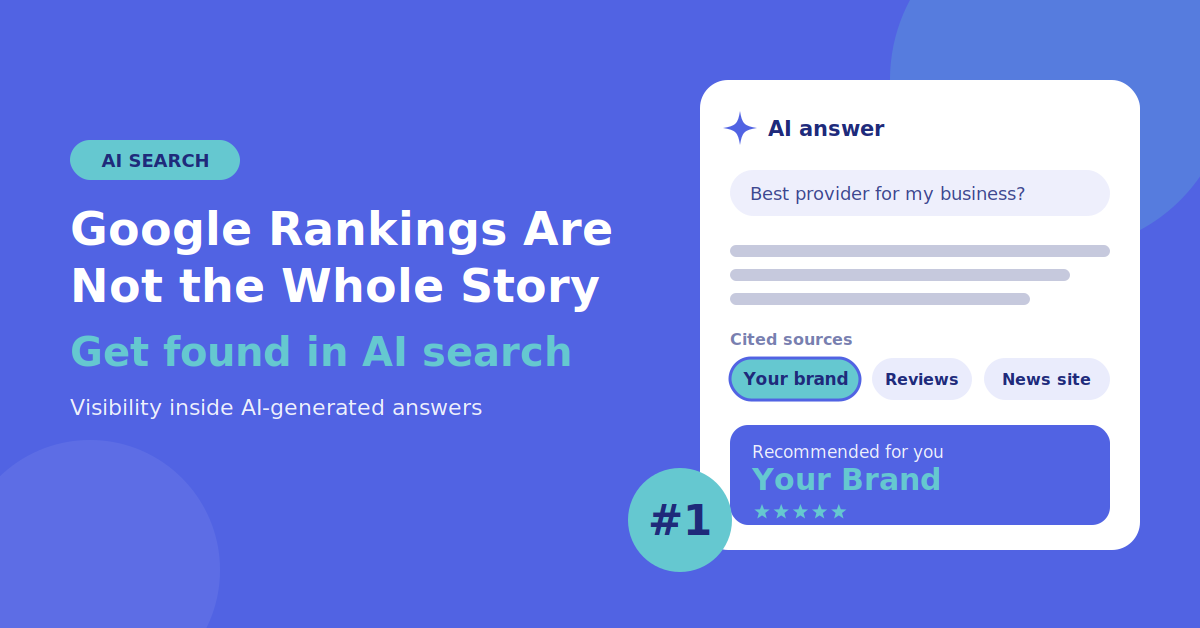
For years, the goal of online visibility was simple: climb the search results and wait for the clicks. That goal still matters, but it no longer describes the full picture. Today, people ask questions to AI assistants, read summarized answers at the top of the results page, and make decisions before they ever visit a website. If your brand is missing from those answers, a first-page ranking may not bring the traffic it used to. This is why AI search optimization for businesses has become a serious priority. In this article, you will learn what it means, why it matters, and how to improve your visibility in AI-generated answers by strengthening brand mentions and publishing content that is genuinely useful and credible.
What AI Search Optimization for Businesses Really Means
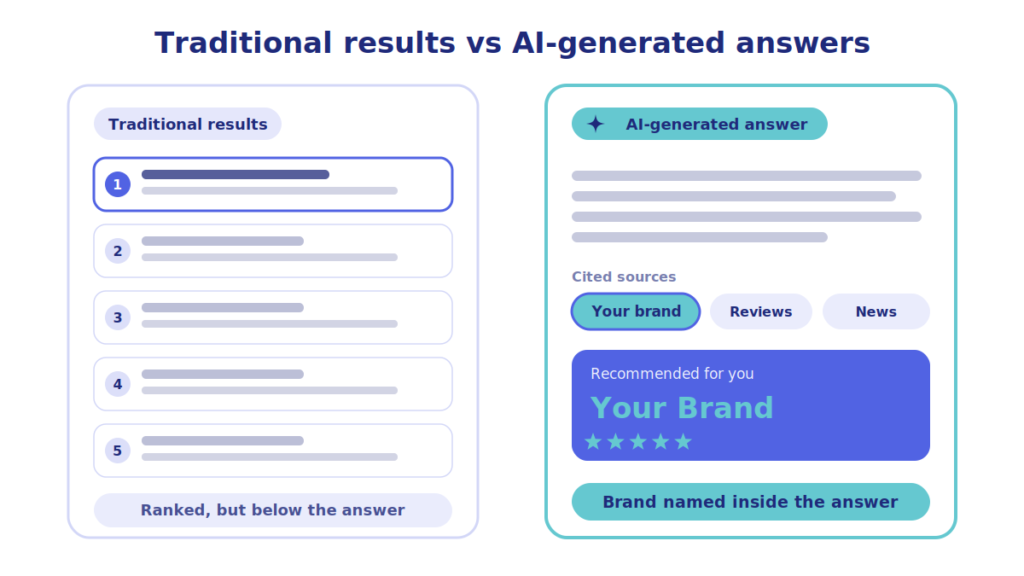
AI search optimization for businesses is the practice of making your brand, your expertise, and your content easy for AI-powered search tools to find, understand, trust, and reference. These tools include AI summaries within traditional search engines, conversational assistants, and answer engines that respond to questions in natural language rather than listing 10 blue links. You may also hear related terms such as generative engine optimization or answer engine optimization. They describe the same shift: instead of competing only for a position on a results page, you now compete to be included in the answer itself.
It helps to understand that AI search does not replace traditional SEO. It builds on top of it. The systems behind AI answers rely heavily on content that is already crawlable, well-structured, and recognized as reliable across the web. A business that ignores the foundations of SEO will struggle to appear in AI answers, while a business that treats AI visibility as a separate trick, disconnected from quality and reputation, will struggle just as much. The real opportunity lies in combining both.
Why Google Rankings Alone Are No Longer Enough
A high ranking used to guarantee attention. Now the page itself often answers the question before a click happens. When a searcher receives a clear summary with a few cited sources, many will accept that summary and move on. The businesses named or linked inside the answer gain trust and traffic, while those that sit below it can become invisible even though their rankings look healthy on a report.
This change also affects how customers discover brands. People increasingly ask assistants for recommendations, comparisons, and explanations, such as which software suits a small team or which service provider is worth hiring. The answers often mention a handful of names. Being one of those names can shape buying decisions long before a sales conversation begins. For small and mid-sized companies, this is both a risk and an opening, because AI tools do not simply favor the biggest advertising budgets. They favor clear, trustworthy, well-supported information, which a focused business can absolutely provide.
How AI Tools Decide Which Businesses to Mention
Although every platform works differently, the logic behind AI answers follows a recognizable pattern. These systems look for content that directly answers a question, comes from a source that appears knowledgeable, and is supported by signals from elsewhere on the web. In other words, they reward relevance, clarity, and corroboration.
Relevance means your content matches the real question people ask, not just a keyword. Clarity means the answer is easy to extract, with plain language and logical structure. Corroboration means other credible sources agree that your business exists, does what it claims, and is worth mentioning. When these three qualities align, your chances of being cited or recommended increase considerably. When one is missing, such as a well-written page from a brand nobody else mentions, visibility tends to stall.
Create Useful Content That Answers Real Questions
The most dependable way to improve AI search optimization for businesses is to publish content that solves problems better than the average page. That starts with understanding your customers’ actual questions. Listen to the queries that arrive through your sales team, support inbox, reviews, and social channels, then build articles and resource pages that answer those questions completely and honestly.
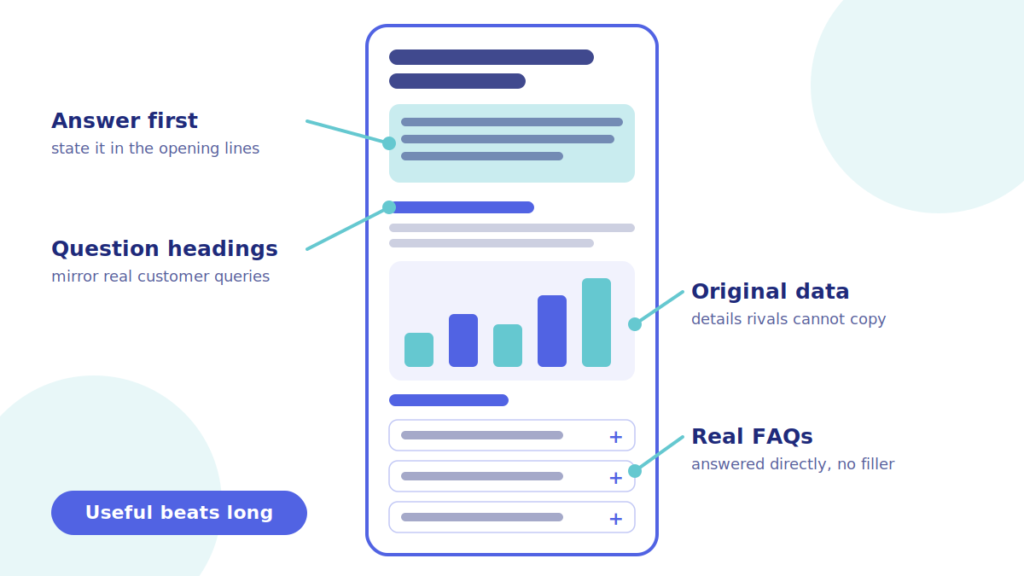
Usefulness is not about length. It is about completeness and precision. A strong page states the answer early, explains the reasoning, addresses common exceptions, and shows how the advice applies in practice. Original value matters enormously here. Content that merely rephrases what ten other pages already say gives an AI system no reason to choose you. Adding your own data, customer examples, process details, pricing context, or lessons learned makes your content distinctive and harder to replace.
It also helps to write in a way that supports extraction. Clear headings that mirror the questions people ask, short paragraphs that open with the main point, and definitions placed near the top of a section all make it easier for AI tools to understand and reuse your information. Frequently asked questions on a page can be valuable when they genuinely reflect customer concerns and are answered directly rather than stuffed with filler.
Build Credibility With Real Expertise and Evidence
Trust is the currency of AI search. Systems that summarize information for millions of people have strong reasons to avoid unreliable sources, which is why signals of experience, expertise, authority, and trustworthiness carry so much weight. Your content should make it obvious who wrote it, why that person is qualified, and where the information comes from.
Practical steps include showing authors’ names with short biographies, linking to reputable sources when citing facts, updating pages as information changes, and displaying your team’s real credentials. Case studies, testimonials, certifications, awards, and transparent business details such as your address, contact information, and policies all contribute to a picture of a legitimate organization. Accuracy is non-negotiable. A single outdated statistic or exaggerated claim can undermine an otherwise strong page, and publishing errors at scale damage the trust you are trying to earn.
First-hand experience deserves special emphasis. Pages that describe what you actually did, tested, built, or observed read differently from generic summaries, and they stand out in a landscape where machine-written text is everywhere. If you use AI tools to help draft content, treat the output as a starting point that must be fact-checked, enriched with real experience, and edited by someone who understands the subject.
Strengthen Brand Mentions Across the Web
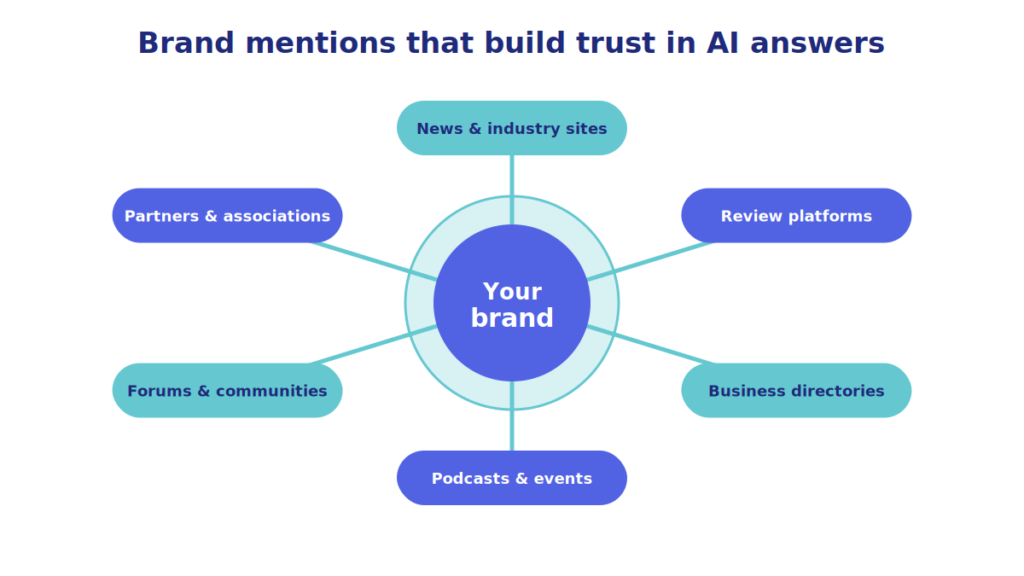
AI systems form an understanding of your brand not only from your website but from everything said about you elsewhere. This is why brand mentions have become such an important part of visibility. When reputable websites, industry publications, directories, podcasts, and communities discuss your business in connection with specific topics, AI tools learn to associate your name with that expertise.
Earning those mentions is a matter of being genuinely worth talking about. Contribute expert commentary to journalists and industry sites, publish original research that others want to reference, speak at events, take part in relevant professional communities, and partner with organizations that share your audience. Consistency also matters. Use the same business name, description, and key facts everywhere, so that AI systems can confidently connect all those references to a single entity rather than treating them as unrelated.
Reviews and third-party opinions play a major role as well. Customer feedback on trusted review platforms, mentions in comparison articles, and discussions on forums and social networks are all sources an AI tool may draw upon when asked for recommendations. Encourage satisfied customers to share detailed experiences, respond professionally to criticism, and pay attention to how your brand is described. If the public image is outdated or inaccurate, correcting it at the source is far more effective than trying to fix it on your own site.
Get the Technical and Structural Foundations Right
Even excellent content cannot be cited if systems cannot access or interpret it. Make sure your important pages can be crawled, load quickly on mobile devices, and are not hidden behind scripts, pop-ups, or login walls that block automated tools. A clean site structure with logical internal links helps both people and machines understand how your topics relate to one another.
Structured data deserves attention as well. Adding schema markup for your organization, articles, products, services, reviews, and frequently asked questions gives search systems explicit information about what a page contains. While markup is not a guarantee of inclusion in any AI answer, it reduces ambiguity and supports a clearer understanding of your business. Maintaining accurate profiles on platforms such as Google Business Profile and professional directories reinforces the same facts from independent places, which strengthens confidence in your details.
Think in Topics and Entities, Not Just Keywords
AI search tends to understand subjects as networks of related ideas rather than isolated phrases. For that reason, building depth around the topics that define your business works better than publishing scattered posts on unrelated themes. Create a core resource for each major subject, then support it with detailed pages that address specific questions, comparisons, use cases, and common problems, linking them together to show how everything fits.
This depth of topical expertise signals to both users and AI systems that your business is a dependable source on the subject, not a casual commentator. It also makes it more likely that, when someone asks a follow-up question, your content will be relevant again. Over time, a connected library of helpful pages can become the reason your brand is mentioned repeatedly across different questions on the same theme.
How to Measure Visibility in AI Search
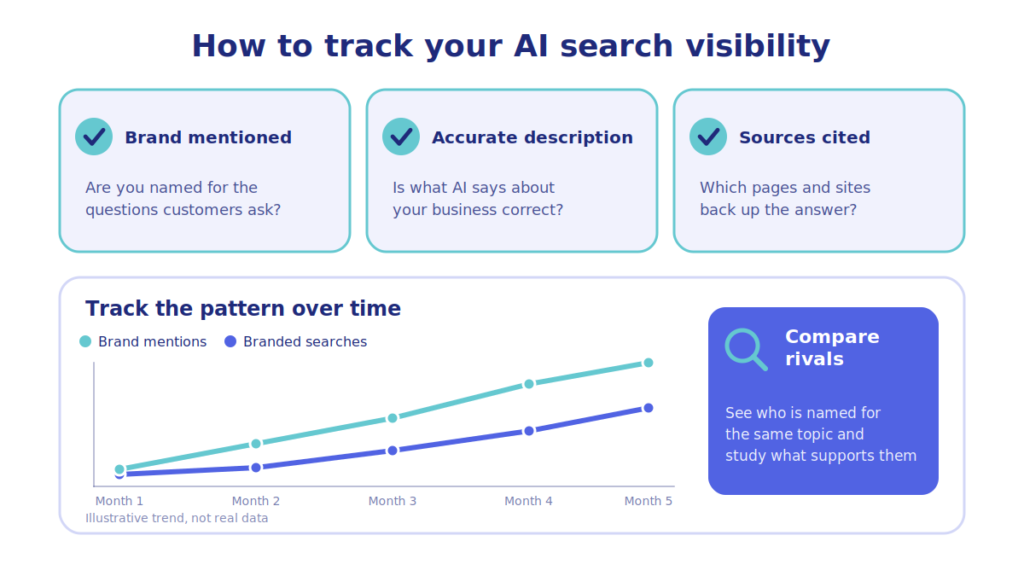
Measurement in this area is still evolving, so a sensible approach combines several signals. Start by regularly asking AI assistants and search engines the questions your customers ask, then note whether your brand appears, how it is described, and which sources are cited. Track branded search volume, direct visits, and referral traffic from AI platforms where your analytics can identify them, and watch whether visitors who arrive this way are more engaged or more likely to convert.
It is also worth monitoring how competitors are represented. If a rival is consistently recommended for a topic you serve well, study the content, mentions, and reviews that may be supporting them. The goal is not to chase every fluctuation but to spot patterns and gaps you can address with better content and stronger reputation signals.
Common Mistakes Businesses Should Avoid
The most frequent mistake is treating AI search as a shortcut. Publishing large amounts of thin, automatically generated content, stuffing pages with questions and answers, or buying low-quality mentions may create activity, but it rarely earns trust and can harm your standing. Another common error is neglecting accuracy by leaving outdated pricing, service descriptions, or inconsistent contact details scattered across the web. Finally, many businesses forget that AI visibility ultimately has to support a business goal. Being mentioned is valuable only when your pages, offers, and follow-up experience turn interest into action.
Conclusion
Search is changing from a list of links into a conversation, and the businesses that adapt will keep earning attention while others wonder why familiar rankings no longer deliver familiar results. AI search optimization for businesses does not demand a complete reinvention. It asks you to do the fundamentals better and with more intention: publish content that truly helps, prove your expertise with evidence and real experience, keep your information consistent, and earn mentions from sources your audience already trusts.
The encouraging reality is that these efforts compound. Useful content attracts references, references strengthen credibility, and credibility increases the chance that AI tools will include your brand in future answers. Start with the questions your customers already ask, answer them better than anyone else, and build a reputation worth repeating. That is the surest path to being found, no matter how people search.