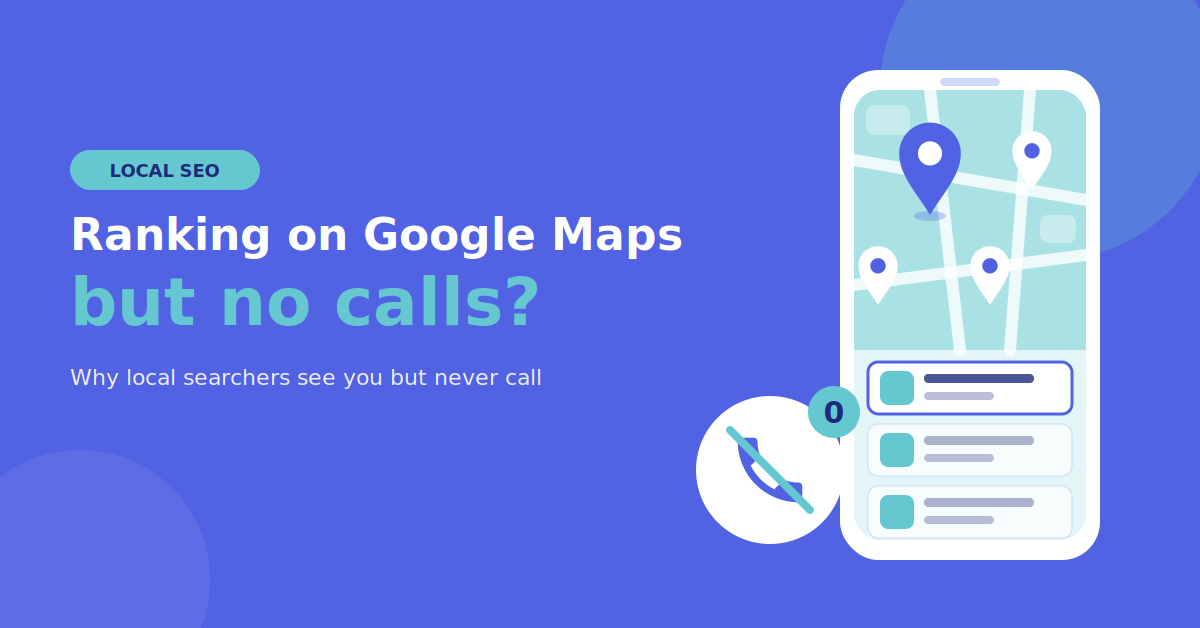
Seeing your business near the top of the local results feels like a victory, until the weeks pass and the phone stays silent. If you are dealing with a Google Maps ranking but no calls, you are not alone, and you are not necessarily doing anything catastrophically wrong. Ranking is only the first step of local search. A listing has to earn attention, build trust, and make it effortless for a searcher to contact you before they ever dial your number. This article explains what a Google Maps ranking-but-no-calls situation really means, why it happens, and how weak business profiles, irrelevant categories, poor reviews, inconsistent details, and underperforming landing pages quietly drain your leads.
What a Google Maps Ranking but No Calls Situation Really Means
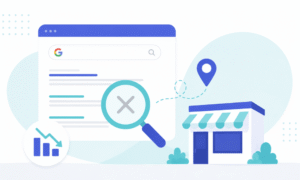
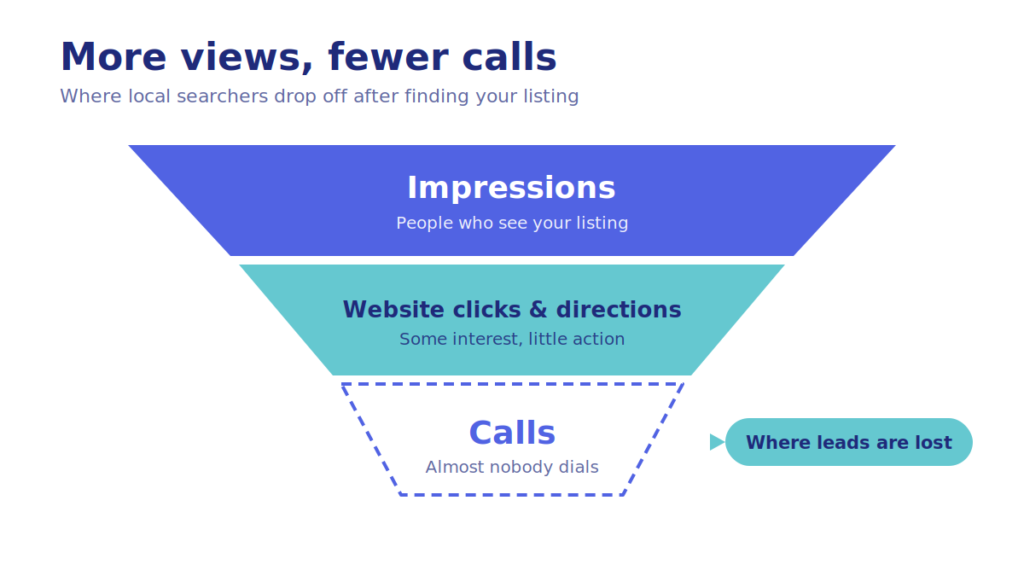
When people say they rank well but receive no calls, they usually mean their business appears in the local pack, the group of three map results shown above the regular organic listings, or near the top of the Maps app. Your visibility reports may show thousands of impressions, yet the call button, website clicks, and direction requests remain disappointingly low. In other words, your Google Business Profile is being seen but not chosen.
This gap between impressions and actions is a conversion problem, not a pure ranking problem. Local SEO has two layers. The first decides where you appear, using signals such as relevance, distance, and prominence. The second decides whether a human being picks you over the competitors sitting right beside you. Many business owners invest heavily in the first layer and ignore the second, which is why a strong position can coexist with an empty inbox.
It is also worth separating real ranking from misleading ranking. You may rank first when someone searches from a block away or when they type your exact business name, yet appear nowhere for the broader, high-intent searches that actually generate customers. Checking where you show up for non-branded searches from different locations gives a much more honest picture.
Why Visibility Without Calls Is So Costly
A local searcher is usually close to a decision. Someone typing a service name plus the words “near me” is often ready to call within minutes, particularly for urgent services like plumbing, dental care, or auto repair. If your listing fails to convince that person in a few seconds, the lead goes to the next result, and you never even learn that you lost it.
This matters because local intent is among the most valuable traffic a business can receive. Customers who find you through the map pack tend to convert at a much higher rate than casual website visitors. When a Google Maps ranking but no calls problem persists, you are effectively paying for marketing, whether through agency fees, time, or advertising, that produces attention without revenue. Fixing the conversion layer often delivers faster returns than chasing even higher rankings, because it improves the value of every impression you already earn.
A Weak Google Business Profile Quietly Pushes Customers Away
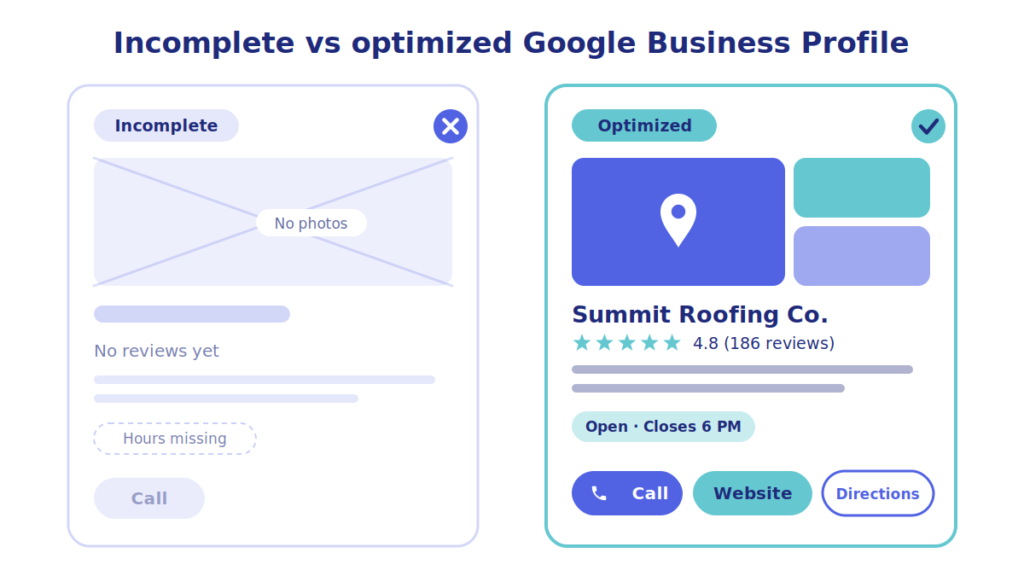
Your Google Business Profile is effectively your storefront window. Searchers judge it in seconds, and an incomplete or neglected profile signals that the business may be inactive, unreliable, or simply not worth the risk. A profile with no photos, a thin description, missing service areas, or outdated opening hours rarely inspires confidence, no matter how high it ranks.
Photos deserve special attention. Real images of your team, premises, completed projects, and products show that the business exists and does good work. Profiles filled with generic stock images or, worse, no images at all feel anonymous. Regularly uploading fresh photos also signals to Google that the listing is actively managed, which supports its prominence over time.
The business description, services list, product listings, and Google Posts are further opportunities to answer the questions a searcher has before calling. Explaining what you offer, who you serve, and what makes you different helps visitors qualify themselves. Features like messaging, appointment links, and Q&A also lower the barrier to contact. A searcher who cannot quickly understand what you do or whether you are open right now will simply move on, and that hesitation is one of the most common reasons behind the “Google Maps ranking but no calls” complaint.
Irrelevant or Poorly Chosen Categories Attract the Wrong Searches
The primary category is one of the strongest relevance signals in local SEO. It tells Google which searches your business should appear for and shapes what customers see directly under your name. If the category is too broad, outdated, or only loosely related to your main service, you may rank for searches that never lead to a sale.
Consider a roofing contractor listed under a generic construction category, or a family law attorney listed simply as a law firm. Both may collect impressions, but the people viewing them are not necessarily looking for those specific services, and the visible label may fail to match what the searcher wants. The result is plenty of views and almost no calls, because the traffic is mismatched with the offer.
The fix is to choose the most specific primary category that describes your core revenue source, then add secondary categories that reflect genuine additional services. Studying the categories used by the top competitors in your market is a practical way to confirm you are aligned with how Google understands your industry. Selecting categories honestly matters too, since stuffing in unrelated ones can dilute relevance and invite suspensions.
Poor Reviews Destroy Trust Before the Phone Rings
Reviews are often the deciding factor between two otherwise similar listings. Searchers scan the star rating, the number of reviews, and the most recent comments almost instinctively. A rating below roughly four stars, a handful of old reviews, or a cluster of unanswered complaints can send potential customers elsewhere within seconds.
The quantity of reviews matters because it signals reliability, but recency matters just as much. A business with hundreds of reviews that all date back several years looks less trustworthy than a competitor with fewer but steady, recent reviews. Detailed reviews that mention specific services and locations also help relevance, so encouraging customers to describe their actual experience is more valuable than collecting vague one-line ratings.
How you respond is equally important. Thoughtful, professional replies to both positive and negative reviews show that a real person cares about customers. A calm response to a harsh review can actually win trust, because future customers read how problems are handled. Ignoring negative feedback or responding defensively tends to reinforce the impression that the business is difficult to deal with. Building a simple, ethical process for requesting reviews after each completed job is one of the most reliable ways to turn a visible listing into a trusted one.
Inconsistent Business Details Confuse Both Google and Customers
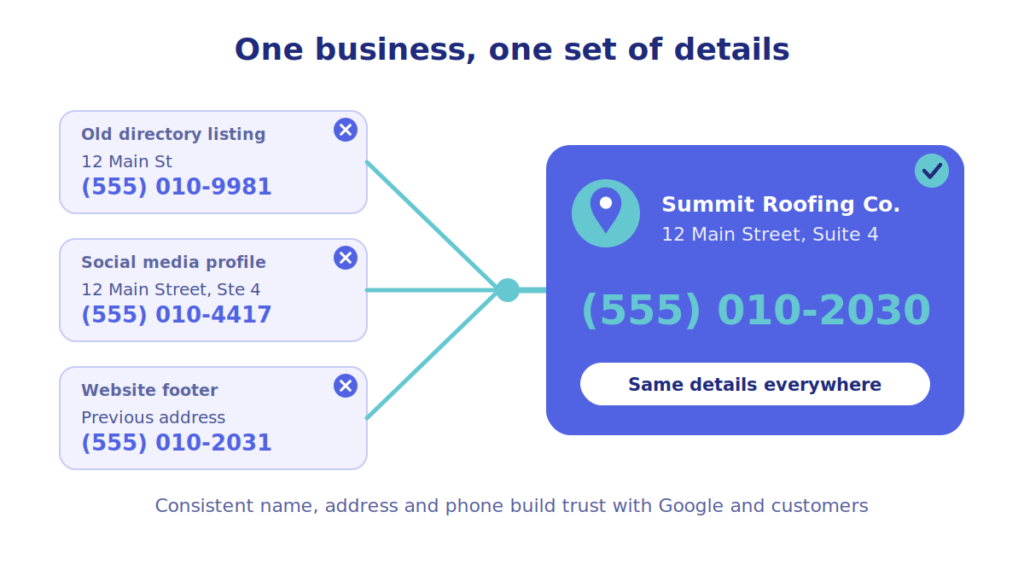
Consistency in your name, address, and phone number, often called NAP, is a foundation of local search credibility. When your details differ across your Google Business Profile, website, social media accounts, and online directories, Google becomes less certain which information is correct, and customers become less certain whether they can rely on it.
The damage can be direct. An old phone number on a directory site, a tracking number that no longer works, or a previous address that still appears on a popular citation can mean that interested customers call a dead line or arrive at the wrong location. Some of those lost calls never show up in your records at all, which makes the problem look like a lack of demand when it is really a data problem.
Opening hours deserve the same scrutiny. If your listing claims you are open when you are not, or lists hours that miss holidays and seasonal changes, searchers who call and get no answer rarely try again. Regularly auditing your citations, correcting duplicates, and maintaining a single approved version of your business details across all platforms protects both your rankings and your reputation. Even small differences, such as an abbreviation in the business name or a missing suite number, are worth fixing, because consistency is what lets Google trust your information enough to keep showing it.
Landing Pages That Fail to Convert Local Searchers
Many searchers click through to your website before deciding to call, and this is where an otherwise healthy listing often falls apart. If the link in your profile leads to a generic homepage that is slow, cluttered, or unclear, visitors have to hunt for basic information. Most will not bother.
A strong local landing page matches the intent behind the search. Someone who found you while looking for emergency drain cleaning should land on a page that speaks directly to that need, shows the service area, highlights proof points such as reviews and certifications, and presents a clear phone number and a call button without requiring scrolling. Mobile performance is critical because the majority of local searches happen on phones, where a slow page, tiny text, or a hard-to-tap number kills the impulse to call.
Messaging also matters. Pages filled with vague claims and corporate language persuade far less than pages that name the town, describe the problem, explain the process, and make the next step obvious. Trust elements such as real photos, guarantees, pricing guidance, and short customer testimonials reassure visitors who are still comparing options. Using click-to-call buttons, visible contact forms, and a consistent call to action reduces friction and directly increases the number of calls generated by the same traffic.
Other Hidden Reasons You May Be Ranking Without Getting Calls
Sometimes the profile and the website look fine, yet the calls still do not arrive. In these cases, it is worth examining more technical and competitive factors. Call tracking may be misconfigured, so calls are happening but not being recorded. Your listing may be ranking in areas where customers are unlikely to hire you because of distance or limited service coverage. A strong competitor with more photos, more recent reviews, and clearer offers can capture attention even when you sit in a higher position.
Pricing perception also plays a part. If your listing suggests premium service but your reviews hint at inconsistent quality, or if nothing indicates what an appointment costs, cautious searchers may keep browsing. Reviewing your insights data, comparing your listing side by side with the three nearest competitors, and even calling your own number to test the experience can reveal friction that is easy to miss from the inside.
Practical Steps to Turn Rankings into Real Phone Calls
The most effective approach is to treat your listing as a conversion asset rather than a ranking trophy. Begin by completing every section of your Google Business Profile, choosing the most accurate primary category, and uploading authentic, recent photos. Then build a steady rhythm of review requests and responses so that your social proof keeps growing. Audit your citations to remove any conflicting details, and ensure the phone number and hours are correct everywhere. Finally, send listing traffic to a fast, mobile-friendly page built specifically for local intent, with a prominent call button and trust signals.
The benefits compound over time. Better engagement signals can support stronger rankings; higher trust leads to more calls; and more completed jobs generate fresh reviews that further strengthen the profile. Rather than paying for more visibility, you begin earning more value from the visibility you already have, which is a far more efficient way to grow a local business.
Conclusion
The “Google Maps ranking but no calls” problem is frustrating, but it is also one of the most fixable issues in local marketing. It tells you that Google already considers your business relevant enough to display, and that the missing piece is persuasion and trust. When your profile is complete, your categories are precise, your reviews are strong and recent, your information is consistent, and your landing page makes calling effortless, the same rankings begin to produce measurable results.
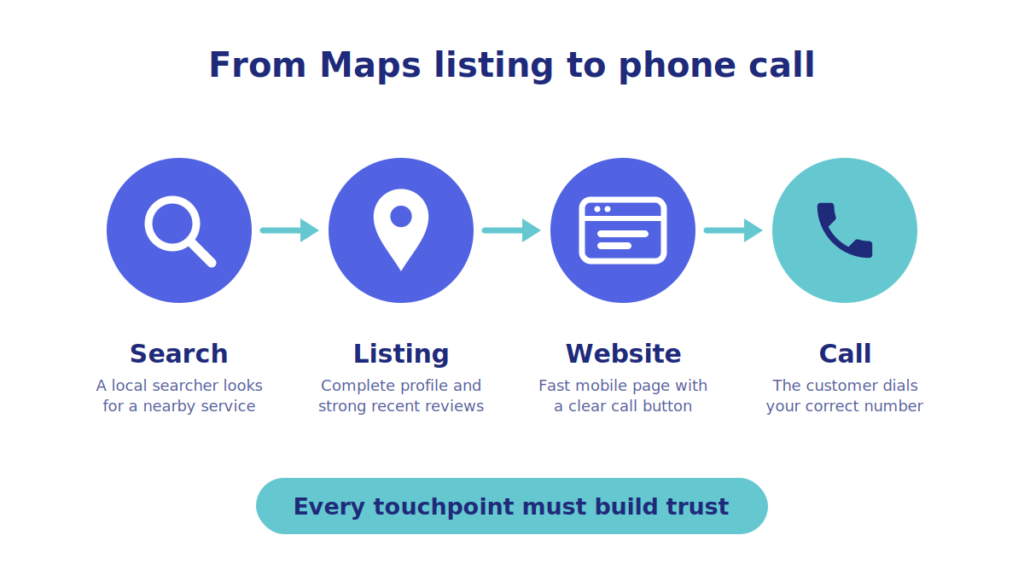
The businesses that win in local search are rarely those with a single lucky ranking. They are the ones that treat every touchpoint, from the map listing to the website to the phone answer, as part of one connected customer journey. If your phone is quiet today, start by looking at your listing through the eyes of a stranger, quickly compare three options, and fix whatever would make you hesitate.