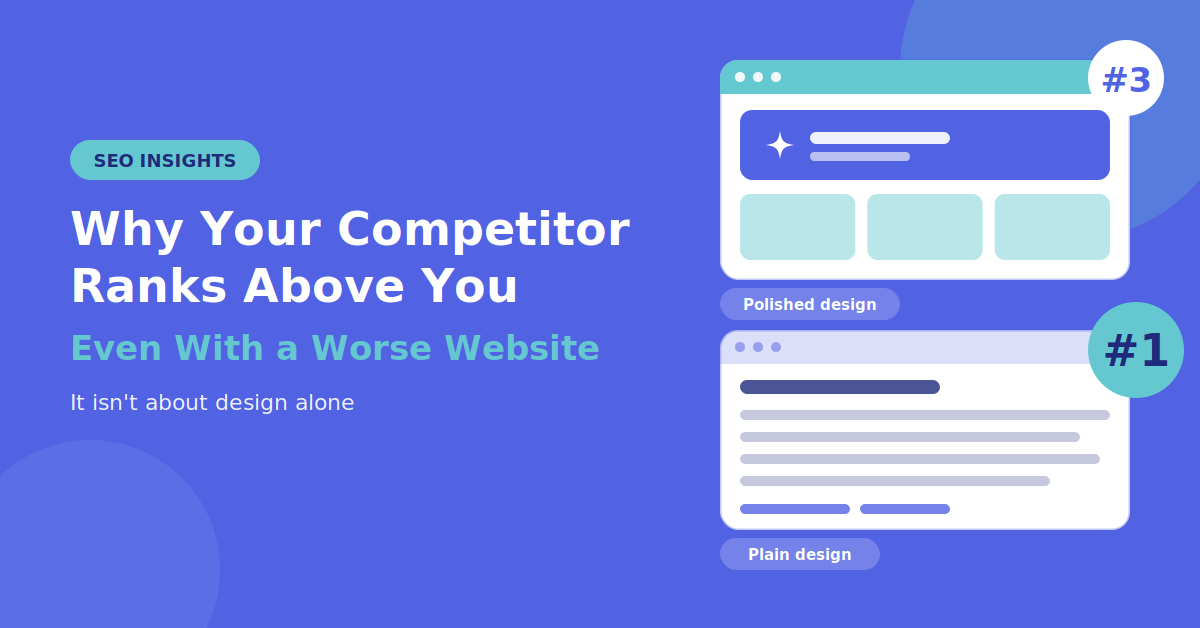
Few things frustrate a business owner more than searching for their own service and finding a competitor ranking higher on Google, especially when that competitor’s website looks dated, loads awkwardly, and seems to have been built a decade ago. You have invested in design, branding, and a polished user experience, so it feels unfair. Yet search engines do not judge a website the way a person admires a storefront. They evaluate whether a page meets the searcher’s needs, whether other websites vouch for it, whether it covers its subject thoroughly, and whether the business behind it can be trusted. In this article, you will learn why a competitor ranking higher on Google can happen even when their website looks worse, and what you can do to close the gap.
Why a Competitor Ranking Higher on Google Is Not About Design
The most important thing to understand is that beauty and ranking power are two different qualities. A polished website helps convert visitors into customers once they arrive, but it does not automatically earn the right to be shown first. Search engines rely on signals that can be measured at scale: the match between a page and a query, the quality and quantity of links pointing to it, the depth of information on a topic, and evidence that real people find the result helpful.
A plain website can score very well on those signals. It may answer a specific question directly, have earned years of mentions from respected sites, and focus tightly on one subject. Meanwhile, a beautiful website may be built mostly from large images, brief slogans, and vague marketing language, leaving search engines with very little to understand. When you see a competitor ranking higher on Google, the real question is not whose site looks better but whose site deserves to be shown for that particular search. Answering that honestly is the first step toward improving your position.
Search Intent: The Reason Your Page May Not Match the Query
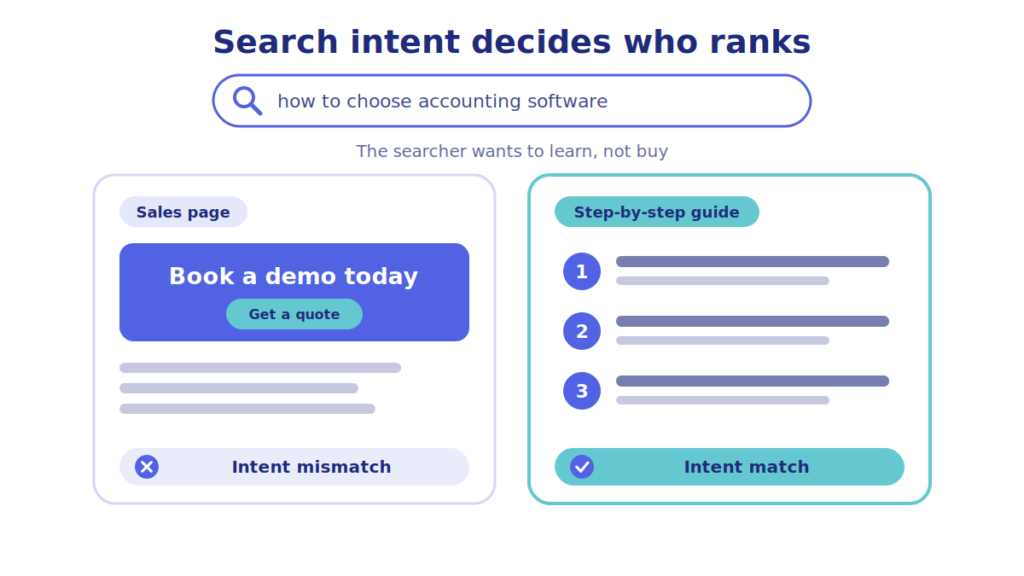
Search intent is the underlying goal behind a query, and it is one of the most common reasons a weaker-looking website outranks a stronger one. People who search for a specific phrase want a specific kind of result. Some want a quick explanation, some want to compare options, some want to find a local provider, and some are ready to buy. Search engines analyze user behavior and then favor pages that best match the dominant intent.
Imagine you sell accounting software and your homepage tries to persuade visitors to book a demo. A competitor has a simple page titled with a clear question and a straightforward explanation, perhaps a step-by-step guide. If most people searching that phrase are trying to learn, the guide fits better than your sales page, no matter how elegant your design may be. The mismatch is not a flaw in your website but a flaw in how your page aligns with the searcher’s goal.
To diagnose this, look at the results currently ranking for your target keyword and note what they have in common. Pay attention to the format, whether they are tutorials, product pages, service pages, lists, or local listings, and to how they begin. If every top result is an informational guide and yours is a hard sell, you have found a strong clue. Adjusting your content to match the intent, or creating a separate page that does, often produces faster gains than any design improvement.
Backlinks: Why Other Websites Matter More Than Appearance
Backlinks remain one of the strongest signals search engines use to gauge authority. When other reputable websites link to a page, they are effectively recommending it. A competitor with a modest site but a long history of earning links from news outlets, industry associations, partners, directories, and bloggers can carry far more authority than a newer, prettier site with few external references.
Not all links are equal, which is why a competitor ranking higher on Google sometimes has fewer total links than you but better ones. A single link from a respected, relevant publication can outweigh dozens of low-quality directory entries. Relevance matters too. Links from websites in your industry or related fields tell search engines that your business is part of the conversation on that subject, while unrelated or spammy links add little and may even create risk.
Age and consistency play a role as well. A business that has been quietly collecting genuine mentions for many years builds a durable advantage, even if its website has barely changed. To compete, focus on earning links the right way: publish original research, create resources that others want to cite, contribute expert commentary, sponsor or participate in community and industry events, and build real relationships with publishers and partners. Buying links or using manipulative schemes can trigger penalties, so patience and quality are the safer approach.
Topical Relevance: Depth Beats Decoration
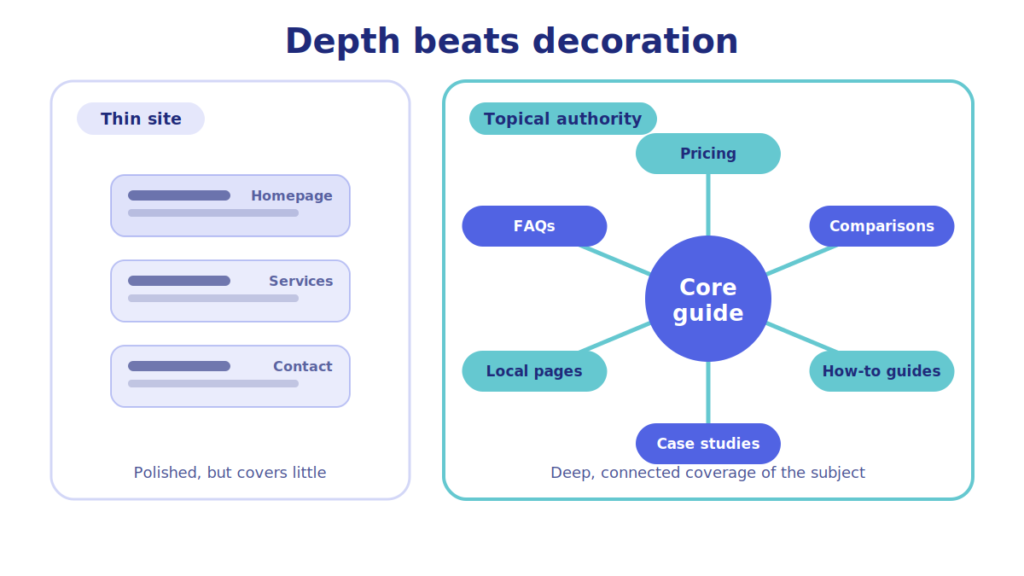
Topical relevance describes how thoroughly and consistently a website covers a subject. Search engines increasingly try to understand whether a site is a genuine source of knowledge on a topic rather than a place that mentions it once. A competitor with dozens of useful articles, service pages, and answers to customer questions around a single theme sends a strong signal of expertise, even if each page is simply formatted.
Your site might look impressive, but it covers its subject lightly, with only a homepage, a services page, and a contact form. In contrast, the competitor may have explained pricing, compared alternatives, answered common objections, and addressed different locations or use cases. When a searcher types a specific, detailed query, the site with the most complete and relevant coverage tends to win.
Building topical authority means planning content around the full range of questions your customers ask. Start with a central page that explains the main subject, then add supporting pages for related questions, comparisons, how-to guides, and case studies, and link them together logically. This structure helps both visitors and search engines understand that your business has depth. It also protects you from relying on a single page to carry all of your rankings.
Trust Signals: Why Credibility Quietly Decides Rankings
Trust is harder to measure, but it influences how search engines treat a website, particularly in areas where bad information can harm people, such as health, finance, legal services, and major purchases. Signals of experience, expertise, authority, and trustworthiness help demonstrate that a business is legitimate and knowledgeable.
A competitor may appear to have a worse website yet display strong trust signals that you are overlooking. Their pages might include named authors with real credentials, detailed customer reviews across multiple platforms, consistent business information, clear policies, and mentions in reputable sources. They may have years of positive brand searches, which show that people actively look for them by name. These factors accumulate quietly and can outweigh superficial advantages such as a modern layout.
You can strengthen your own trust signals by showing who is behind your content, adding author biographies, collecting and responding to reviews, keeping your contact details accurate across platforms, and backing your claims with evidence. Transparency about who you are, what you offer, and how customers can reach you makes a real difference for both search engines and the people deciding whether to contact you.
Technical Basics That Even Simple Sites Often Get Right
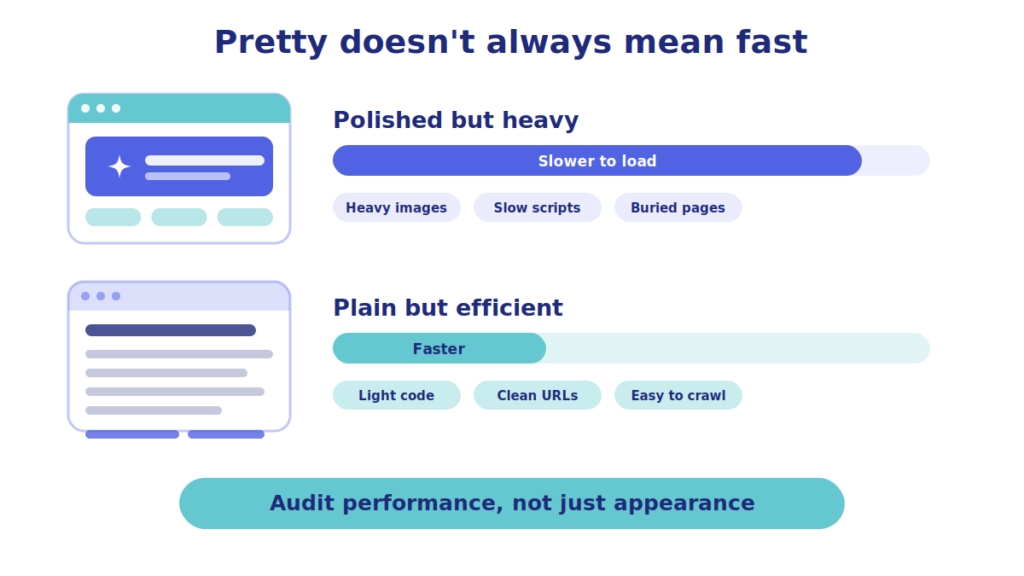
It is also worth checking the technical side before assuming the competitor has some secret advantage. A basic website can still be fast because it carries little unnecessary code. It may be easy for search engines to crawl when URLs are clean, the structure is sensible, and there are no accidental blocks. Meanwhile, a visually rich site can suffer from heavy images, slow scripts, hidden content that search engines struggle to read, or navigation that buries important pages.
Running a thorough audit of your own site often reveals problems that design work has masked. Pages that are not indexed, duplicate content, missing title tags, weak internal linking, and slow mobile performance can all hold back an otherwise attractive website. Fixing these issues does not change how your site looks, but it can change how well it performs.
Local and Brand Signals Can Tip the Balance
For businesses that serve a specific area, proximity and local prominence can override many other factors. A competitor with a better-optimized Google Business Profile, more reviews, and consistent listings across directories may rank above you for local searches even if your website is far more attractive. Brand strength matters as well. If people frequently search for a competitor by name, follow their social accounts, or mention them in conversation online, search engines interpret that as a sign of real-world popularity.
This is a reminder that ranking results from many signals working together. A competitor ranking higher on Google may be benefiting from a long reputation, loyal customers, or a strong offline presence that has gradually translated into online visibility.
How to Overtake a Competitor Who Ranks Above You
The path forward begins with an honest comparison. Study the competitor’s ranking pages and ask what they do better, not visually but substantively. Check whether their content answers the query more directly, whether they cover more related questions, how many credible sites link to them, and how trustworthy their business appears across the web. Compare their search presence, reviews, and brand mentions with yours.
Then build a plan based on the gaps you find. Align your page with the dominant search intent, expand your content to cover the topic more completely, earn links and mentions from relevant, reputable sources, strengthen your trust signals, and fix any technical problems that limit performance. Keep your attractive design, because it supports conversion, but treat it as one part of a broader strategy rather than the strategy itself. Progress will take time, since links, authority, and trust accumulate gradually, but the improvements compound and become difficult for rivals to reverse.
Conclusion
Seeing a competitor ranking higher on Google despite a weaker-looking website can be discouraging, but it reveals something useful: search visibility is earned through relevance, authority, depth, and trust, not through appearance alone. Your competitor may be matching search intent more precisely, collecting stronger backlinks, covering their topic more completely, or presenting clearer proof that they can be relied upon.
The good news is that each of these advantages can be matched and surpassed. By understanding what searchers truly want, creating comprehensive content, earning credible links and mentions, and demonstrating your expertise openly, you can combine the strength of a well-built website with the signals that search engines value most. When design and substance work together, the ranking gap tends to close, and your better website finally gets the visibility it deserves.