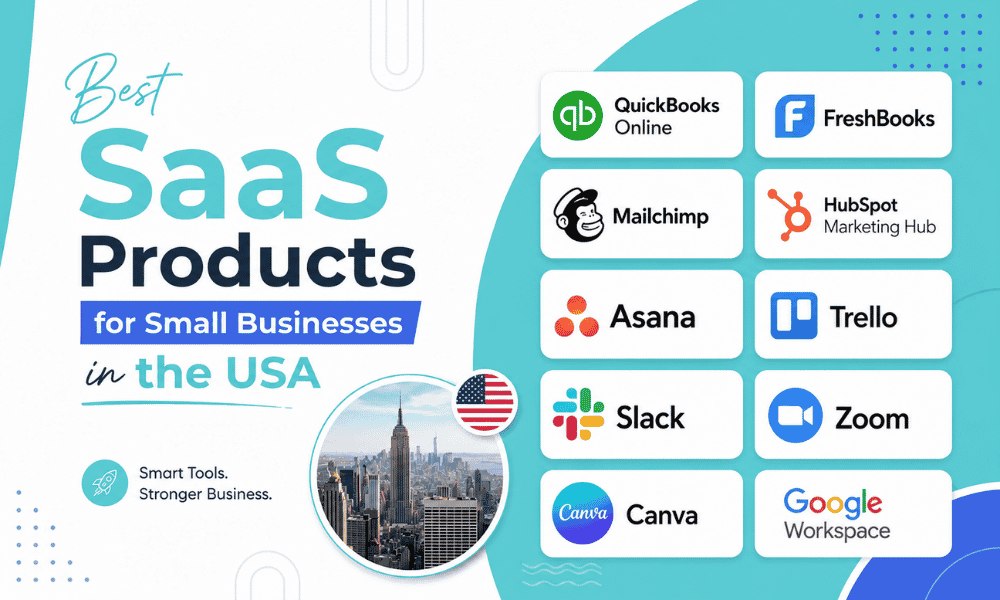
Running a small business in the USA has never been more competitive. You are up against larger companies with bigger teams, bigger budgets, and more resources. The one area where the playing field has genuinely leveled out is software.
Finding the best SaaS products for small businesses is now one of the smartest investments you can make as an owner. Cloud-based tools let a five-person team operate with the same efficiency as a company ten times its size. According to Gartner, 85% of all business software spending will go toward SaaS by the end of 2026. And closer to home, nearly 82% of small businesses in the USA have already invested in at least one SaaS solution.
The right SaaS tools for small businesses do not just cut costs. They eliminate the manual work that eats up your team’s day, reduce errors, and give you visibility into your business that you simply cannot get with spreadsheets and email threads.
This guide covers the best cloud-based tools for small teams, organized by category, with honest notes on pricing and who each tool works best for.
What Makes a SaaS Product Worth It for a Small Business?
Before getting into the list, it helps to know what to look for. Not every SaaS tool marketed for business productivity actually delivers. A good product should do four things:
Solve a real problem without creating three new ones. Some tools promise to do everything and end up doing nothing well.
Fit your budget without locking you in. The best affordable SaaS tools offer tiered pricing that scales with your business. You should be able to start small and upgrade as you grow.
Be easy to set up and use. Small businesses rarely have a dedicated IT person. If you need a consultant to get started, it is probably the wrong tool.
Connect with your other tools. The best SaaS platforms for startups and growing businesses are the ones that work together. When your tools automatically share data, your team spends less time on manual entry and more time on actual work.
With that in mind, here are the top picks for 2026-27.

Category 1: Accounting and Finance
1. QuickBooks Online
QuickBooks Online is the most widely used cloud accounting software for small businesses in the USA. It handles invoicing, expense tracking, payroll, tax preparation, and bank reconciliation in one place.
The interface has improved significantly in recent years, and the mobile app makes it easy to track expenses and send invoices on the go. For small businesses that file quarterly taxes, the automatic mileage-tracking and tax-estimation features alone save hours of work each year.
According to a 2026 survey by the National Small Business Association, 67% of small businesses that switched to cloud-based accounting software saved more than five hours per week on financial admin tasks.
Best for: Small businesses, freelancers, and retail operations that need full-service accounting.
Pricing: Starts at $17/month (Simple Start). Advanced plans go up to $117/month.
Key features: Invoicing, expense categorization, payroll add-ons, bank integrations, tax prep tools
2. FreshBooks
FreshBooks is the go-to cloud software for small business owners who bill clients by the hour. Where QuickBooks leans toward product-based businesses and inventory management, FreshBooks is built around time tracking, hourly billing, and client invoicing.
You track time directly in the app, attach it to a project, and generate a professional invoice in a few clicks. It is one of the most affordable SaaS tools in the accounting category, making it a strong choice for solo operators and small service teams. It is one of the best cloud software for small business.
Best for: Freelancers, consultants, agencies, and service businesses.
Pricing: Starts at $19/month. Higher tiers unlock unlimited clients and team members.
Key features: Time tracking, recurring invoices, expense management, client portal, project profitability reports
Category 2: Marketing and Email
3. Mailchimp
Mailchimp remains the most accessible email marketing tool among all SaaS tools for small businesses. You do not need a marketing background to use it. The drag-and-drop builder is intuitive, the templates are professional, and the audience segmentation tools let you send targeted emails rather than blasting the same message to your entire list.
Email marketing consistently delivers one of the highest returns on investment of any marketing channel. For small businesses with tight marketing budgets, Mailchimp lets you run campaigns that look and feel polished without hiring an agency.
Best for: Small businesses running email newsletters, promotions, and automated customer journeys.
Pricing: Free plan available for up to 500 contacts. Paid plans start at $13/month.
Key features: Drag-and-drop email builder, audience segmentation, automation workflows, analytics, e-commerce integrations
4. HubSpot Marketing Hub
If your business is growing and you need more than just email, HubSpot Marketing Hub is one of the best SaaS products for small businesses looking for an all-in-one solution. It covers email campaigns, landing pages, forms, social media scheduling, and SEO recommendations in a single platform.
The free CRM bundled with HubSpot is one of the best deals in small business software subscriptions. You get contact management, deal tracking, and basic email marketing at no cost, and you can unlock more powerful features as your budget allows.
Best for: Growing small businesses that want an all-in-one marketing and CRM platform.
Pricing: Free CRM available. Marketing Hub paid plans start at $20/month.
Key features: CRM, email marketing, landing pages, lead tracking, analytics, social scheduling
Category 3: Project Management and Productivity
5. Asana
Asana is one of the strongest SaaS options for business productivity, particularly for small teams juggling multiple projects. Tasks can be viewed as lists, boards, or timelines depending on how your team thinks about work.
The automation features are particularly useful. You can set up rules that automatically assign tasks, send reminders, or move work to the next stage when something is completed. That reduces the mental load of manually tracking everything, letting your team focus on getting things done.
Best for: Small teams managing multiple projects and deadlines simultaneously.
Pricing: Free plan for up to 10 users. Paid plans start at $10.99/user/month.
Key features: Task management, timeline views, workflow automation, 200+ integrations, reporting dashboards
6. Trello
Trello is one of the best cloud-based tools for small teams that want simple, visual task tracking without a steep learning curve. Tasks live as cards on a board, and you move them from column to column as work progresses. There is nothing complicated about it, which is exactly what makes it so popular.
For small businesses running content calendars, onboarding checklists, or straightforward project workflows, Trello is fast to set up and easy for anyone on the team to pick up on day one. Things make it one of the best cloud-based tools for small teams:
Best for: Small teams that prefer visual task management and minimal setup time.
Pricing: Free plan available. Paid plans start at $ 5 per user per month.
Key features: Kanban boards, drag-and-drop cards, checklists, due dates, integrations with Slack and Google Workspace

Category 4: Communication and Collaboration
7. Slack
Slack has become the standard for internal business communication and earns a spot on any list of the best SaaS products for small businesses with remote or hybrid teams. It replaces scattered email chains with organized channels, making it far easier to keep conversations in context and find information when you need it.
As one of the most widely adopted affordable SaaS tools for communication, Slack connects with over 2,000 apps, including Google Drive, Asana, and Zoom, so your team can get updates and take action without switching between a dozen platforms.
Best for: Any small business with a team that communicates regularly, especially remote or hybrid setups.
Pricing: Free plan available. Paid plans start at $7.25/user/month.
Key features: Organized channels, direct messaging, file sharing, 2,000+ app integrations, searchable message history
8. Zoom
Zoom is still the most reliable video conferencing tool in the market for small business software subscriptions focused on communication. The interface is clean, the video quality is consistently good, and features like screen sharing, breakout rooms, and session recording make it useful well beyond basic calls.
For client meetings, team standups, or any situation where a face-to-face conversation matters, Zoom gets everyone into a virtual room quickly and without technical headaches.
Best for: Small businesses that hold regular video meetings with clients or remote team members.
Pricing: Free for meetings up to 40 minutes. Paid plans start at $15.99/user/month.
Key features: HD video and audio, screen sharing, cloud recording, breakout rooms, calendar integration
Category 5: Customer Relationship Management
9. HubSpot CRM (Free)
HubSpot’s free CRM is one of the best SaaS platforms for startups building their first formal sales process. It gives you a complete view of your pipeline, contact history, and deal stages at zero cost. You can track emails, log calls, set follow-up reminders, and manage your entire client list without paying anything.
For small businesses that are not yet ready to commit to a paid CRM, HubSpot Free is the smartest starting point available.
Best for: Small businesses and startups formalizing their sales process for the first time.
Pricing: Free forever for core CRM features.
Key features: Contact management, deal tracking, email tracking, meeting scheduling, basic reporting
10. Salesforce Starter
For small businesses that have outgrown a basic CRM, Salesforce Starter delivers enterprise-grade capabilities at a price that works for smaller teams. It is widely recognized as one of the best SaaS products for small businesses with an active sales operation that needs detailed pipeline visibility.
Salesforce is the largest publicly traded SaaS company in the USA, with a market cap of $236 billion as of early 2026, and the Starter plan makes that platform accessible to businesses of any size.
Best for: Small businesses with an active sales team needing full CRM and customer service tools.
Pricing: Starts at $25/user/month.
Key features: CRM, sales automation, customer service tools, reporting dashboards, AppExchange integrations
Category 6: Design and Content
11. Canva
Canva is one of the most popular affordable SaaS tools for small businesses that need regular design work without a dedicated in-house designer. With thousands of ready-made templates, a drag-and-drop interface, and a massive library of images and icons, you can produce social media graphics, presentations, flyers, and marketing materials in minutes.
As a solution built specifically for SaaS business productivity in the creative space, the Brand Kit feature stores your logo, colors, and fonts, so every design automatically maintains consistency with your brand identity.
Best for: Small businesses that need regular design work without hiring a full-time designer.
Pricing: Free plan available. Pro plan starts at $15/user/month.
Key features: Drag-and-drop design, thousands of templates, Brand Kit, team collaboration, social media scheduling
Category 7: Cloud Storage and File Management
12. Google Workspace
Google Workspace gives small businesses professional Gmail with a custom domain, Google Drive for cloud storage, Docs and Sheets for real-time collaboration, and Google Meet for video calls. Everything is connected and works together without friction.
Looking for the best cloud software for small businesses at an accessible price point, Google Workspace is hard to beat. At $6 per user per month, it is one of the best value SaaS tools for small businesses on the market. As one of the most complete cloud software for small businesses, it covers communication, storage, and collaboration in a single subscription.
Best for: Small businesses wanting an all-in-one productivity suite at an affordable price.
Pricing: Starts at $ 6 per user per month.
Key features: Gmail with custom domain, Google Drive, Docs, Sheets, Slides, Meet, Calendar
How to Build a SaaS Stack That Actually Works for Your Business
Picking individual tools is the easy part. Getting them to work well together is where most small businesses run into problems. Here are three practical rules to follow when assembling your SaaS stack for business productivity.
Start with your biggest bottleneck. Do not try to overhaul everything at once. Identify the one area where your team wastes the most time or makes the most errors, and fix that first. Many of the best SaaS platforms for startups succeed because they focus on solving one core problem effectively before expanding. Add more tools only after the first one is running smoothly.
Check for integrations before you commit. Before signing up for any small-business software subscription, check what the tool connects with natively. A project management platform that does not sync with your email or communication tool creates more manual work, not less. The best cloud-based tools for small teams are those that slot into your existing workflow without requiring workarounds, a key trait of the best SaaS platforms for startups.
Audit your subscriptions every six months. The average company wastes $18 billion annually on unused SaaS licenses, and small businesses are not immune. Set a calendar reminder every six months to review which tools your team actually uses and cancel anything that has gone quiet. Staying lean and efficient is exactly how the best SaaS platforms for startups help businesses maintain productivity without unnecessary costs.
Final Thoughts
The global SaaS market hit $317 billion in 2025 and is on track to reach $390 billion by 2027. For small businesses in the USA, that growth means more options than ever and more noise to cut through.
The best SaaS products for small businesses are the ones that solve real problems, fit your budget, and grow with you. You do not need all twelve tools on this list. Start with the categories where your business has the biggest gaps, confirm the tools integrate with each other, and build from there. With the right SaaS tools for small businesses in place, your team spends less time on admin work and more time on the things that actually build your business.