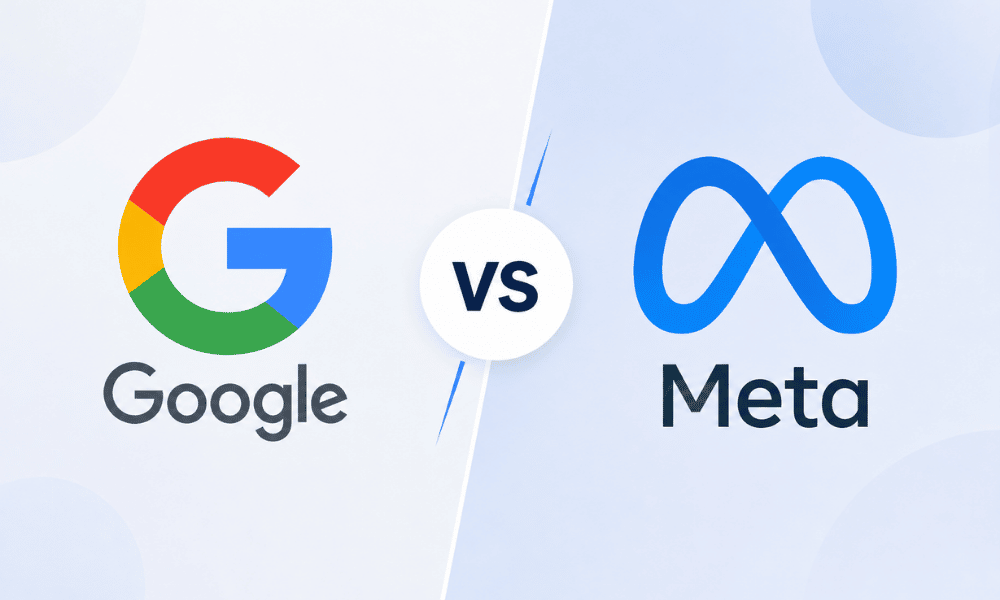
If you have ever sat down to plan a paid media budget, you have probably run into the same debate every marketer has had at least once: Google Ads vs Meta Ads, which one should get the bigger slice of the pie? It is one of the most common questions business owners and marketing teams ask, and honestly, there is no one-size-fits-all answer.
Both platforms are advertising giants. Both can drive real revenue. But they work in completely different ways, and understanding that difference is what separates campaigns that convert from campaigns that quietly drain your budget. This guide breaks down the real differences between Google Ads and Meta Ads, how they compare on cost, targeting, and creative, and how to decide which one fits your business right now.
What Is Google Ads
Google Ads is the advertising platform that lets businesses show up when someone actively searches for something on Google. It also covers the Google Display Network, YouTube ads, Shopping ads, and Performance Max campaigns, but the heart of the platform is search intent.
Here is the simplest way to think about it. Someone types “emergency plumber near me” into Google because their pipe just burst. That person is not browsing. They are ready to act. Google Ads puts your business directly in front of that kind of high-intent moment.
This is what makes Google Ads so effective at capturing existing demand. You are not creating interest; you are meeting people at the exact moment they are looking for a solution. It is a big reason Google Ads so often comes out ahead in a Google Ads vs Meta Ads comparison focused purely on high-intent buyers.
How Google Ads Bidding Works
Google Ads runs on an auction-based system using keywords. Advertisers bid on search terms relevant to their business, and Google determines ad placement using a mix of bid amount, ad quality, and expected relevance to the searcher. This is why a well-optimized ad with a strong quality score can outrank a competitor bidding higher but with weaker relevance.
What Are Meta Ads
Meta Ads covers advertising across Facebook, Instagram, and, increasingly, Messenger and the Audience Network. Unlike Google, Meta Ads are not built around search intent. They are built around interruption and discovery.
Think about scrolling through Instagram on a Sunday afternoon. You are not looking for a new skincare brand or a pair of running shoes. You are catching up with friends and killing time. Then an ad appears for a product that looks exactly like something you would want, and suddenly you are curious enough to tap through.
That is the core mechanic of Meta advertising. It does not wait for demand; it creates it. This is often the biggest point of confusion when people compare Google Ads vs Facebook Ads because the two platforms solve completely different problems. It also explains why so many Google Ads vs. Meta Ads discussions end up talking past each other, since one side is arguing about intent and the other about reach.
How Meta Ads Targeting Works
Meta builds its targeting around user data, such as interests, behaviors, and demographics, as well as lookalike audiences based on your existing customers. Instead of matching to a search query, Meta matches your ad to a person’s profile and predicted interests. This makes it incredibly powerful for reaching people who fit your ideal customer profile, even if they have never heard of your brand.
Key Differences Between Google Ads and Meta Ads
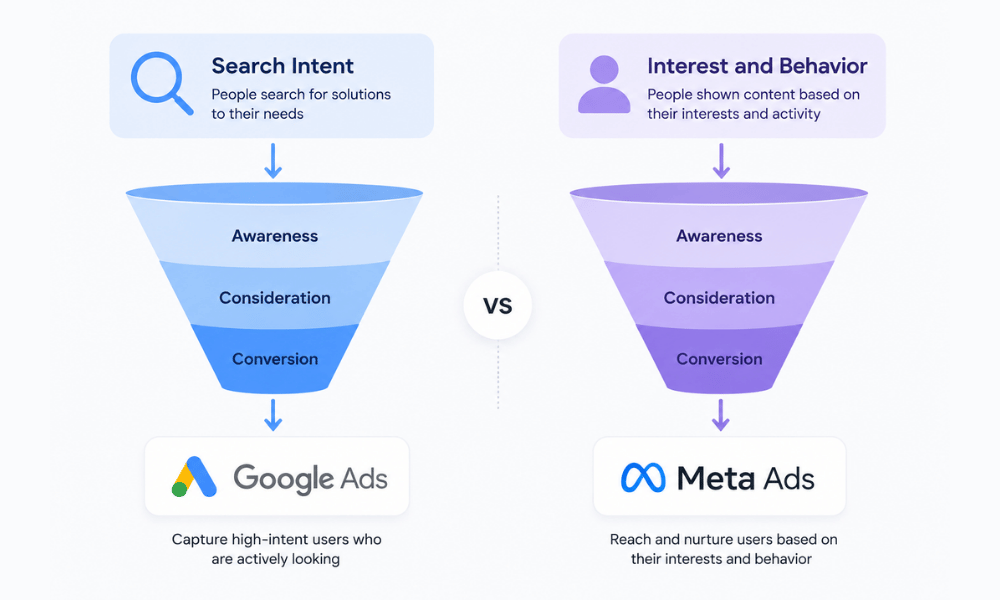
The difference between Google Ads and Meta Ads really comes down to one core idea: intent versus discovery.
Google Ads targets people who already know what they want. They are actively searching, comparing, or are ready to buy. Meta Ads targets people based on who they are and what they are likely to be interested in, even before they know they want your product.
Neither approach is better across the board. They simply solve different marketing problems. If someone needs a demand that already exists, Google wins. If someone needs to build awareness or introduce a new product to the right audience, Meta wins.
This is really the foundation of any comparison between Meta Ads and Google Ads. Once you understand this, the rest of the decision becomes much easier.
Targeting Comparison
Targeting is one of the clearest places a Google Ads vs Meta Ads comparison shows real, practical differences rather than just theory.
Google Ads Targeting
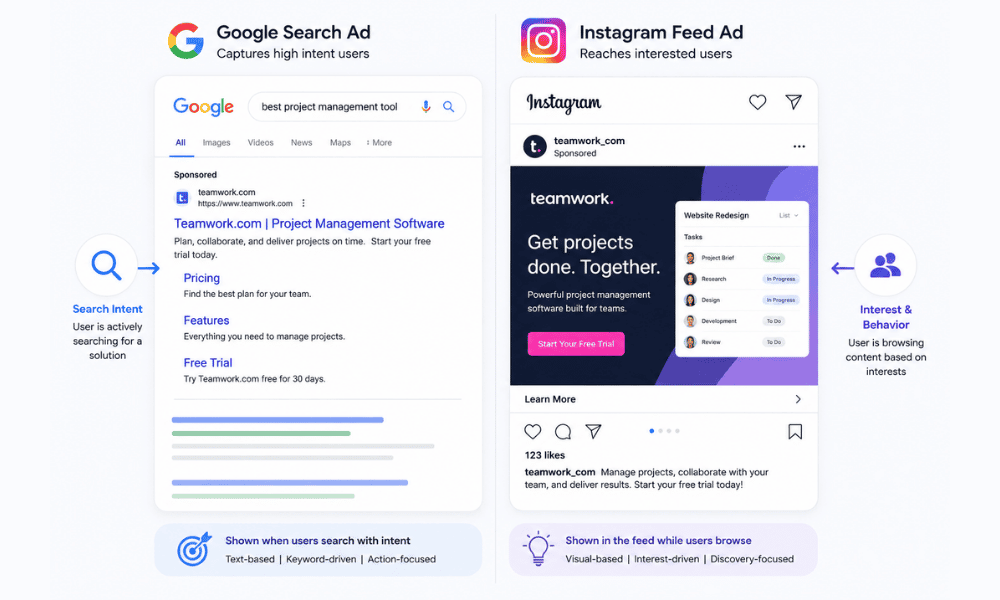
Google Ads targeting starts with keywords and then layers in additional signals such as location, device, time of day, audience segments, and remarketing lists. The strength here is precision around what someone is actively looking for right now.
For example, a local moving company can target “movers in Austin, TX” and reach people who are actively planning a move, not just people who fit a demographic profile that might need moving services someday.
Meta Ads Targeting
Meta Ads targeting is built on interests, behaviors, life events, and lookalike audiences. You can target people who recently got engaged, people who follow fitness influencers, or people who behave similarly to your best existing customers.
This makes Meta especially strong for businesses that know their ideal customer profile well but are trying to reach people before they start actively searching. A new skincare brand launching a product line has no existing search demand to capture, so Meta becomes the better starting point.
Cost and ROI Comparison
Cost is where a lot of businesses get tripped up, because “which platform is cheaper” is the wrong question. The real question is which platform generates a better return for your specific offer. Any honest Google Ads vs Meta Ads breakdown has to look past click price and into what happens after the click.
Google Ads tends to have a higher cost per click, especially in competitive industries such as law, insurance, and home services. But because the traffic already has intent, conversion rates are often higher, which can offset the higher cost per click.
Meta Ads generally have a lower cost per click and cost per impression. However, because you are reaching people who are not actively looking to buy, per-click conversion rates tend to be lower. The tradeoff is scale and reach at a lower entry cost.
A practical example helps here. A B2B software company selling a niche compliance tool will likely see stronger ROI from Google Ads, because the buyers already know they have a problem and are searching for solutions. On the other hand, a direct-to-consumer clothing brand launching a new collection will often see stronger ROI from Meta Ads, because visual discovery drives impulse purchases better than search ever could.
Average Cost Ranges to Expect
Costs vary widely by industry, but in general, Google Ads clicks in competitive niches can range from a few dollars to well over $50 per click in industries like legal services. Meta Ads clicks are usually much lower, often in the $1–$3 range, depending on audience size and competition. These numbers shift constantly, so always check current auction data for your specific industry before setting a budget.
Ad Formats and Creatives
Google Ads Formats
Google Ads formats lean heavily on text and structured data. Search ads are headline and description-driven. Shopping ads pull data from product feeds, including images, pricing, and reviews. Display and YouTube ads add a visual layer, but the foundation of Google Ads is still built around matching intent, not stopping a scroll.
Meta Ads Formats
Meta Ads are built for visual storytelling. Image ads, video ads, carousels, and Reels ads all rely on strong creative to grab attention in a crowded feed. This is a major operational difference. Google Ads campaigns can succeed with solid copywriting and a smart keyword strategy. Meta Ads campaigns live or die by creative quality.
If your team is stronger at writing persuasive search copy than producing scroll-stopping video content, that alone might tilt your strategy toward Google. The reverse is true if you have a strong content or design team.
Funnel Positioning
Understanding where each platform fits in your marketing funnel makes budget allocation much clearer, and it is where a Google Ads vs Meta Ads comparison starts to feel less like a competition and more like two tools built for different jobs.
Google Ads performs best at the middle and bottom of the funnel, where people already understand their problem and are evaluating solutions. This includes branded search, competitor comparison searches, and high-intent product searches.
Meta Ads performs best at the top and middle of the funnel, where the goal is to build awareness, generate interest, and nurture people who are not ready to buy yet. Retargeting campaigns on Meta also work extremely well for warming up website visitors who did not convert on their first visit.
Many successful brands actually run both in tandem. Meta builds the awareness and interest, and Google captures the resulting demand once people start searching by name or by category.
When to Use Each Platform
If you are still weighing Google Ads vs Meta Ads for an upcoming campaign, these scenarios make the decision much more concrete.
Choose Google Ads When
Your product or service already has search demand. People actively type queries related to what you sell, whether that is “best CRM software for small business” or “wedding photographer Chicago.” Google Ads is also strong for local service businesses, high-intent purchases, and situations where you need to quickly capture bottom-of-funnel buyers.
Choose Meta Ads When
You are launching something new that people do not yet know to search for. You have visually appealing products or a strong brand story. You want to build an audience over time using retargeting and lookalike modeling. Meta also works well for impulse purchase categories like fashion, beauty, home goods, and lifestyle products.
Choose Both When
You have the budget to run a full funnel strategy. Many mature e-commerce and B2B brands use Meta to generate awareness and Google to close the loop on people who later search directly for the brand or product category. This combination often outperforms either platform on its own.
Final Verdict
There is no universal winner in the Google Ads vs. Meta Ads debate, and any guide claiming otherwise is oversimplifying. Google Ads wins when intent already exists. Meta Ads wins when you need to create that intent from scratch.
The smartest approach is not picking a side permanently. It is understanding your product, your buyer journey, and your creative capabilities, then matching your budget to where your ideal customer actually is in their decision process. Start by asking one simple question: Are people already searching for what I sell, or do I need to introduce them to it first? That single answer will point you toward the right platform, or toward the smarter path of running both together.
Key Takeaways
The Google Ads vs Meta Ads decision ultimately comes down to where your customer is in their journey. Google Ads captures existing demand through search intent, making it ideal for high-intent purchases and local services. Meta Ads creates new demand through visual discovery, making it ideal for brand awareness and impulse-driven categories. Cost per click is usually lower on Meta, but conversion rates often favor Google due to buyer intent. The strongest long-term strategy for many businesses combines both platforms, using Meta to build awareness and Google to convert the resulting demand.
FAQ: Google Ads vs Meta Ads
Which is better, Google Ads or Meta Ads?
Neither platform is universally better. Google Ads works best when people are already searching for what you sell, since it captures existing intent. Meta Ads works best when you need to build awareness or introduce a product to people who are not actively searching yet. The right choice depends on your product, your audience, and where buyers are in their decision process.
Is Meta Ads the same as Facebook Ads?
Meta Ads is the broader term that covers advertising across Facebook, Instagram, Messenger, and the Audience Network. Facebook Ads technically refers to just the Facebook platform, but in practice, most marketers use the two terms interchangeably since campaigns are usually managed together through Meta Ads Manager.
Which platform is cheaper, Google Ads or Meta Ads?
Meta Ads generally have a lower cost per click and cost per impression than Google Ads. However, cheaper clicks do not always mean better results. Google Ads often converts at a higher rate because the traffic already has purchase intent, which can make it more cost-effective overall, even with a higher cost per click.
Can I run Google Ads and Meta Ads at the same time?
Yes, and many successful brands do exactly that. A common approach is to use Meta Ads to build awareness and generate interest, then use Google Ads to capture demand once people start searching for the brand or product by name. Running both together often outperforms relying on a single platform.
Which platform is better for a small business with a limited budget?
It depends on the type of business. A local service business with clear search demand, such as a plumber or a dentist, usually gets more value starting with Google Ads. A new product-based business without existing search volume, such as a fashion or beauty brand, often sees better early results from Meta Ads due to its lower entry cost and visual discovery strength.
Do Google Ads and Meta Ads use the same kind of targeting?
No. Google Ads targeting is built around keywords and search intent, along with signals like location and device. Meta Ads targeting is built around interests, behaviors, demographics, and lookalike audiences modeled from your existing customers. This is one of the biggest differences between Google Ads and Meta Ads, and it directly affects how each platform should be used.
Which platform works better for e-commerce?
Both platforms play a role in e-commerce, just at different stages. Meta Ads performs well for product discovery and impulse purchases, especially with strong visual creative. Google Ads, particularly Shopping campaigns, tend to perform well for capturing shoppers who are actively comparing products and are close to making a purchase decision.
How do I decide which platform to start with?
Ask whether your ideal customer is already searching for your product or service. If the answer is yes, start with Google Ads to capture that existing demand. If the answer is no, or if you are launching something new, start with Meta Ads to build awareness first. From there, you can expand into a combined strategy as your budget and data grow.