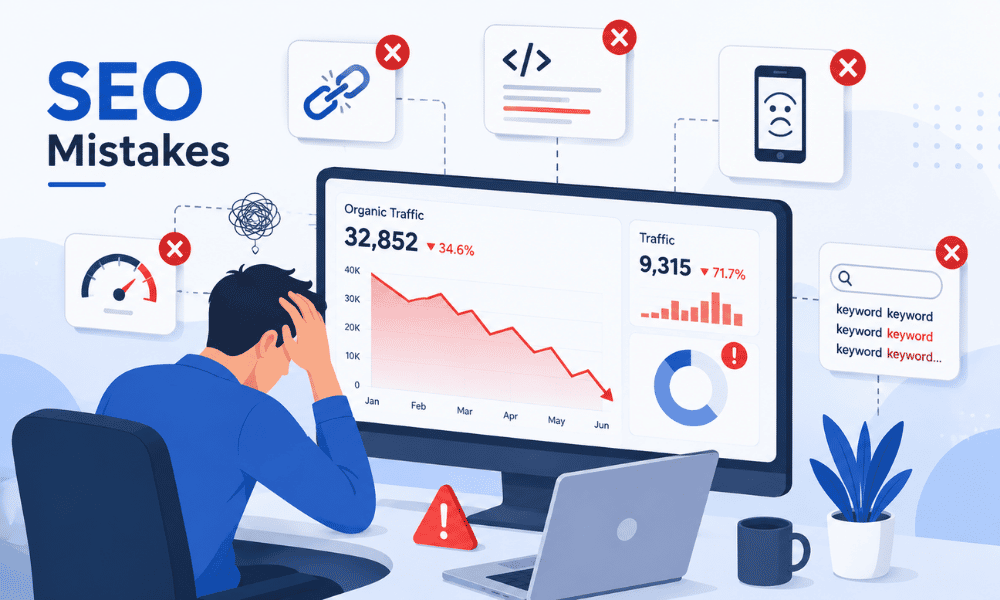
If your traffic has plateaued or started sliding even though you’re publishing regularly, the problem usually isn’t a lack of effort. It’s one or two common SEO mistakes quietly working against you in the background. Search engines have gotten smarter, competition has gotten fiercer, and the margin for error has gotten smaller.
The frustrating part is that most of these issues are fixable in an afternoon once you know what to look for. This article walks through common SEO mistakes that recur, whether you’re running a small blog, an e-commerce store, or a B2B site trying to generate leads. We’ll cover what each mistake looks like in practice, why it hurts your rankings, and exactly how to fix it.
Why Common SEO Mistakes Are So Easy to Miss
Most sites don’t lose traffic overnight. It happens gradually, a few positions dropped here, a page that stops getting indexed there, until one day you check your analytics and wonder where everyone went. That slow bleed is exactly why common SEO mistakes are so dangerous. Nothing sets off an alarm. There’s no crash, no error message, just a quiet erosion of visibility.
The good news is that once you know the usual suspects, spotting them on your own site becomes a lot easier.
1. Targeting the Wrong Keywords
This is probably the most common SEO mistake of all, and it happens at the very start of the content process. Businesses often chase high-volume keywords that sound impressive in a report but have nothing to do with what their actual customers are searching for. A local plumbing company trying to rank for “plumbing” nationally is fighting a battle it can never win, while ignoring long-tail searches like “emergency plumber near me” that would actually convert.
The fix is to build content around search intent rather than search volume alone. A keyword with 200 monthly searches that matches exactly what your buyer is looking for will outperform a 10,000-search keyword that’s only loosely related to your business.
2. Weak or Missing On-Page SEO
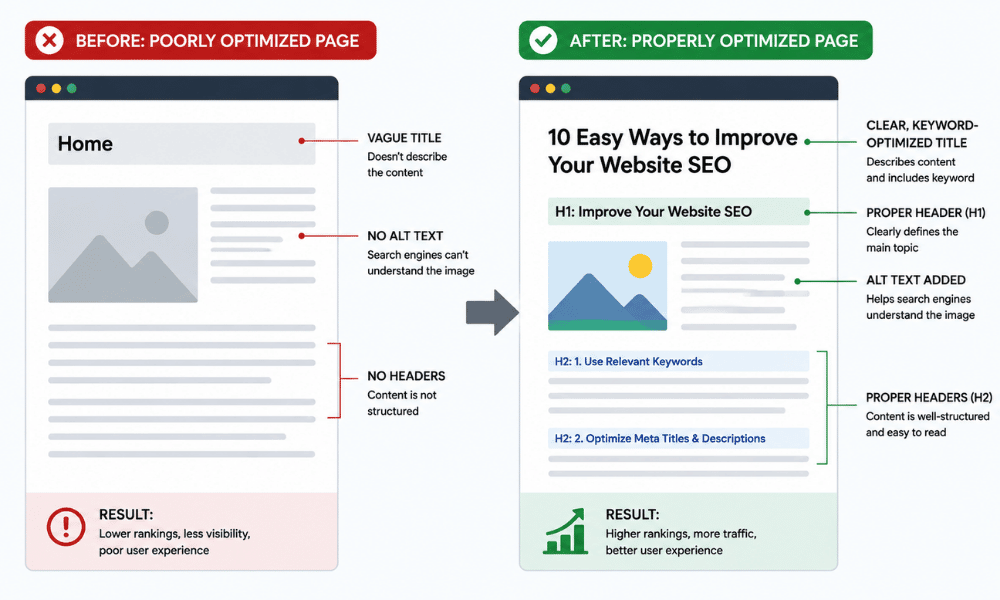
Title tags, meta descriptions, header structure, and image alt text still matter, even in 2026. One of the most common SEO mistakes we see is pages with generic titles like “Home” or “Blog Post 12,” headers that skip straight from H1 to H4, and images with no alt text.
Search engines rely on these signals to understand what a page is actually about. Skipping them doesn’t just hurt accessibility, it makes it harder for your content to rank for anything at all. A quick on-page audit, checking that every page has a unique title, a descriptive meta description, and a logical heading hierarchy, catches most of this in one pass.
3. Ignoring Page Speed and Core Web Vitals
Page speed used to be a nice-to-have. Now it’s a ranking factor that can quietly tank your visibility, no matter how good your content is. Bloated images, unoptimized code, and too many third-party scripts are among the most common SEO mistakes that affect technical performance.
Run your key pages through a speed-testing tool and focus on loading time, interactivity, and visual stability. Compressing images, enabling browser caching, and removing scripts you don’t actually use will usually get you most of the way there without touching a line of custom code.
4. Publishing Thin or Duplicate Content
Search engines have gotten very good at spotting content that exists purely to fill a page rather than answer a question. Thin content, pages under a few hundred words that don’t really say anything, is one of the more common SEO mistakes on older sites that have grown organically over the years without much cleanup.
Duplicate content is a close cousin of this problem. Copying product descriptions from a manufacturer or publishing near-identical pages for slightly different locations confuses search engines about which version should rank. The fix is either to consolidate thin pages into one comprehensive resource or to rewrite them with genuinely useful, original information.
5. Broken Links and Poor Internal Linking
Every broken link is a small trust signal chipped away, both for users and for search engines crawling your site. Combine that with weak internal linking, where your best content isn’t linked from anywhere else on the site, and you end up with pages that are essentially invisible even though they technically exist.
Run a link audit at least once a quarter. Fix or redirect broken links, and make sure your most important pages are linked from multiple places, especially from high-traffic pages that already have authority to pass along.
6. Neglecting Mobile Optimization
More than half of search traffic now comes from mobile devices, and search engines primarily use the mobile version of your site for indexing. Sites that still treat mobile as an afterthought, with tiny text, buttons too close together, or layouts that break on smaller screens, make one of the more visible common SEO mistakes that visitors will notice within seconds of landing on the page.
Test your key pages on an actual phone, not just by resizing a browser. Small friction points that seem minor on a desktop screen often become dealbreakers on mobile.
7. Skipping Structured Data and Schema Markup
Schema markup helps search engines understand context, like whether a page is a recipe, a product, an FAQ, or a review. Sites that skip this miss out on rich results such as star ratings, FAQ dropdowns, or price snippets that make a listing stand out in search results.
This is a low-effort, high-impact fix. Adding FAQ, review, or product schema where relevant usually takes less than an hour per page template and can noticeably improve click-through rates.
8. Overlooking Technical SEO Basics
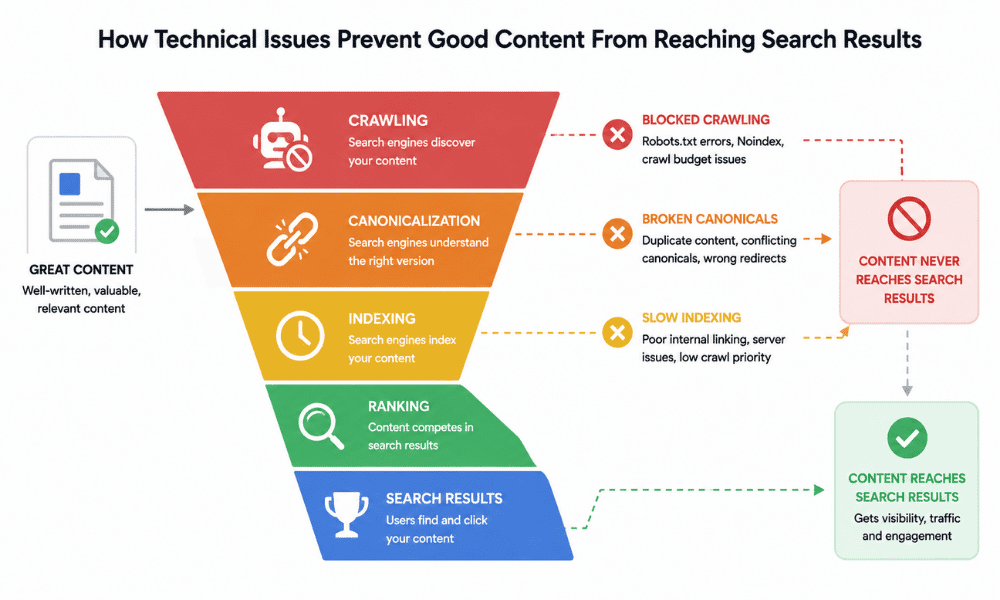
Crawl errors, incorrect canonical tags, and pages accidentally blocked from indexing are some of the most damaging common SEO mistakes because they can hide an entire section of your site from search engines without any obvious symptoms. A single misconfigured robots.txt file has taken down rankings for sites far larger than most people would expect.
Check your indexing coverage report regularly. If pages you expect to rank aren’t showing up in search results at all, this is usually the first place to look.
9. Chasing Backlinks Instead of Earning Them
Buying low-quality backlinks or joining link exchange schemes is still a common SEO mistake that can get a site penalized, rather than just underperforming. Search engines have become very effective at identifying unnatural link patterns.
A better approach is building genuinely link-worthy content, original research, useful tools, or thorough guides, and reaching out to relevant sites that would legitimately benefit from linking to it. It’s slower, but the results are more durable rather than risky.
10. Ignoring Search Intent
Ranking for a keyword doesn’t help if the content doesn’t match what the searcher actually wants. Publishing a long product comparison article when the searcher just wants a quick answer, or vice versa, is a subtle but common SEO mistake that hurts engagement metrics like time on page and bounce rate, both of which can indirectly affect rankings.
Before writing anything, search for the keyword yourself and see what’s currently ranking. That’s usually the clearest signal of what search intent actually looks like for that query.
11. Not Tracking Performance Data
It’s hard to fix common SEO mistakes you don’t know you’re making. Sites that don’t regularly check search performance data, organic traffic trends, or keyword rankings often keep repeating the same errors for months or years without realizing it.
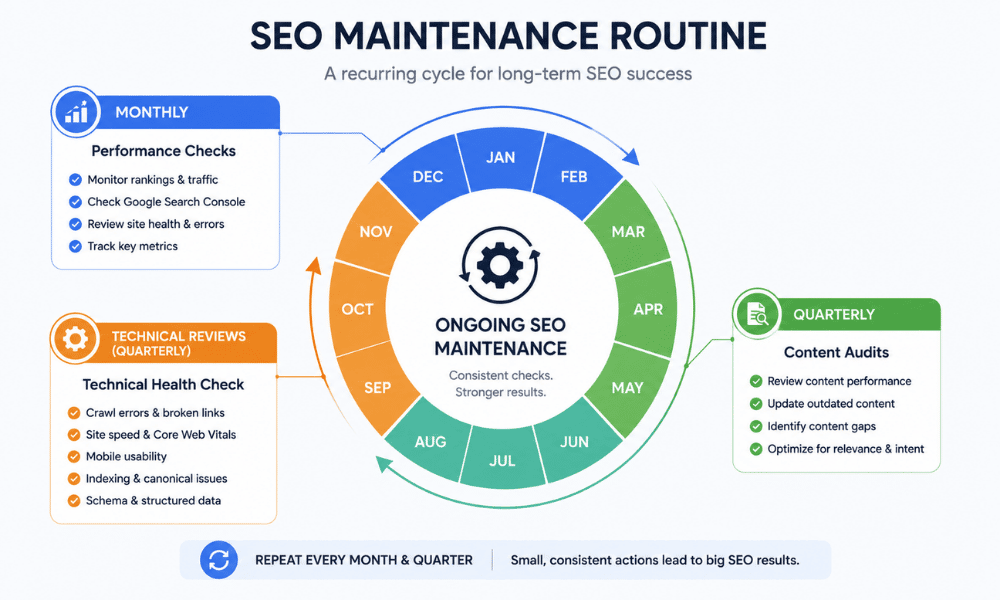
Set a recurring monthly check-in, even just thirty minutes, to review which pages are gaining or losing traffic and why. Patterns become obvious when you look at the data consistently, rather than only when something feels wrong.
12. Treating SEO as a One-Time Project
Perhaps the most common SEO mistake of all is treating SEO as something you do once and then forget about. Algorithms change, competitors publish new content, and old pages become outdated. A site that hasn’t been revisited in a year is quietly losing ground, even if nothing was technically done wrong.
Building a habit of quarterly content audits, technical checks, and keyword reviews keeps a site competitive instead of letting it slowly fall behind.
Key Takeaways
- Most traffic loss comes from a slow accumulation of common SEO mistakes rather than one dramatic error
- Keyword targeting, on-page basics, and page speed are foundational issues worth checking first
- Technical problems like crawl errors and blocked indexing can silently hide entire sections of a site from search results
- Backlinks should be earned through useful content, not purchased or exchanged
- Regular audits and performance tracking are the best defense against repeating the same mistakes over time
Fixing common SEO mistakes isn’t about chasing the newest ranking trick. It’s about getting the fundamentals right and revisiting them consistently, so the traffic you work hard to earn doesn’t quietly slip away.
FAQ: Common SEO Mistakes
1. What are the most common SEO mistakes small businesses make? The most common SEO mistakes small businesses make are targeting keywords that are too broad or competitive, skipping basic on-page SEO like title tags and meta descriptions, and neglecting mobile optimization. These issues are often easy to fix but get overlooked because they don’t cause an obvious, immediate problem.
2. How do I know if I’m making common SEO mistakes on my website? Start by checking your search performance data for pages that have lost traffic over time, reviewing your indexing coverage for pages that aren’t appearing in search results, and running page speed tests on your key landing pages. A steady decline rather than a sudden drop is usually a sign of an underlying, ongoing mistake.
3. Can common SEO mistakes get my site penalized? Some can. Buying low-quality backlinks, using duplicate or thin content, or manipulating keywords through stuffing can trigger algorithmic penalties or manual actions. Most common SEO mistakes gradually hurt rankings rather than cause an outright penalty, but a few carry real risk.
4. How often should I audit my site for SEO mistakes? A quarterly audit is a reasonable baseline for most sites, covering technical issues, on-page elements, and content performance. Larger or fast-growing sites may benefit from monthly checks, since new pages and changes can introduce new issues more quickly.
5. Does page speed really affect SEO rankings? Yes. Page speed and Core Web Vitals are recognized ranking factors, and slow-loading pages tend to have higher bounce rates, which can further hurt performance. Even strong content can underperform if the page itself is slow to load or unstable while rendering.
6. What’s the difference between thin content and duplicate content? Thin content refers to pages that are too short or shallow to genuinely answer a search query, while duplicate content refers to pages with identical or nearly identical text appearing in multiple places, either on your own site or copied from elsewhere. Both can be common SEO mistakes that limit how well a page can rank.
7. Is buying backlinks a common SEO mistake worth avoiding? Yes. Purchased or exchanged backlinks are against most search engine guidelines and can result in penalties if detected. Earning backlinks through useful, original content is slower but far more sustainable for long-term rankings.
8. How long does it take to recover from common SEO mistakes? Recovery time depends on the severity of the issue and how quickly it’s fixed. Technical fixes, such as resolving indexing errors, can show improvement within a few weeks, while recovering from content or backlink issues often takes a few months as search engines re-crawl and re-evaluate the site.