
Every marketing budget meeting eventually comes down to the same question: where should the next dollar go? Paid ads promise instant traffic. Social media promises reach. And SEO sits there quietly, asking for patience and monthly retainers with no guaranteed timeline. So it makes sense that business owners and marketing leads keep typing the same search into Google: Is the ROI of SEO actually worth it, or is it a slow-burning money pit dressed up in technical jargon?
The honest answer is that the ROI of SEO in 2026 is stronger than it’s been in years, but only when it’s done with a clear strategy and realistic expectations. Search behavior has shifted, AI-powered search results have changed how people find answers, and the brands treating SEO as a long-term asset rather than a quick fix are the ones pulling ahead. This article breaks down exactly how to think about the ROI of SEO, how to calculate it, what it costs, and whether it deserves a place in your 2026 budget.
What Is SEO ROI and Why It’s Different in 2026
SEO return on investment is simply the value you get back from organic search traffic compared to what you spend to get it. That sounds straightforward, but the ROI of SEO is trickier to measure than a Facebook ad’s cost per click because the returns show up over months, not hours.
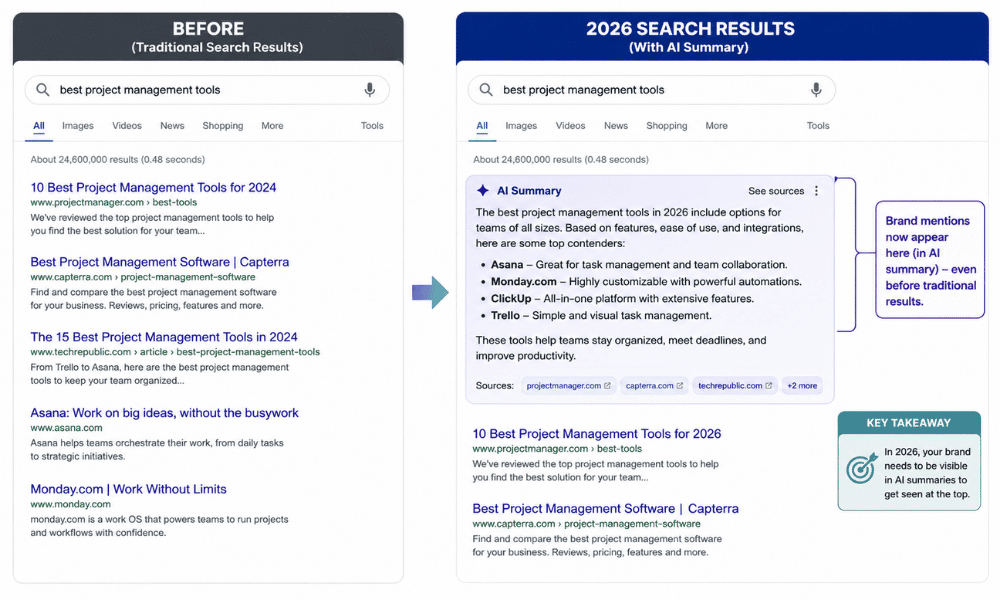
In 2026, the calculation has gotten more complex for a good reason. Search engines now blend traditional blue links with AI-generated summaries, and a growing share of searches never result in a click at all. That doesn’t mean SEO stopped working. It means the definition of a “win” has expanded to include brand visibility inside AI answers, not just clicks to your website. Anyone measuring the ROI of SEO using only click-through data is missing a real chunk of the value.
How to Calculate the ROI of SEO
The formula itself hasn’t changed much over the years:
SEO ROI = (Value of Organic Traffic − Cost of SEO) / Cost of SEO x 100
The hard part is filling in the numbers correctly. Here’s a practical way to do it.
Step 1: Total Your SEO Costs
This includes content production, technical fixes, link building, tools like Ahrefs or Semrush, and either an in-house salary or an agency retainer. Be honest here. Underestimating cost is the number one reason businesses miscalculate their SEO ROI later.
Step 2: Assign Value to Organic Traffic
Look at your organic conversions, then multiply by your average order value or average deal size. If you run an e-commerce store, this is fairly clean. If you’re in B2B, you’ll need to factor in your close rate on organic leads versus leads from other channels.
Step 3: Plug It Into the Formula
If you spent $4,000 a month on SEO and it generated $16,000 in attributable revenue, your ROI would be 300 percent. That’s a strong return, and it’s a realistic outcome for a business that’s invested consistently for 12 months or more.
Why the ROI of SEO Matters More in 2026
Paid channels have gotten more expensive and less predictable. Ad costs on Google and Meta have climbed steadily for the past several years, and iOS privacy changes keep making retargeting less reliable. Against that backdrop, the ROI of SEO looks increasingly attractive because organic traffic doesn’t disappear the moment you pause spending.
Think of it this way. A paid campaign is like renting an apartment. The moment you stop paying rent, you’re out. SEO is closer to buying a home. It takes more upfront work and patience, but once it’s built, it keeps generating value with far lower ongoing cost. Businesses that ranked well for competitive terms years ago are still benefiting from that early investment today, often at a fraction of what it would cost to buy the same traffic through ads.
There’s also a compounding effect that paid media simply doesn’t offer. Every piece of content you publish and every backlink you earn adds to a growing asset. A blog post from two years ago can still be quietly driving leads today, something a Google Ads campaign from two years ago cannot do.
SEO Costs: What You’re Actually Investing In
Before deciding whether the ROI of SEO makes sense for your business, it helps to know where the money actually goes.
- Content creation: writers, researchers, and editors producing articles, landing pages, and resources that target real search intent
- Technical SEO: site speed, crawlability, structured data, and mobile performance
- Link building: earning backlinks from relevant, credible sites to build authority
- Tools and software: keyword research, rank tracking, and competitor analysis platforms
- Strategy and management: whether that’s an in-house SEO lead or an agency retainer
Small businesses might spend $1,500 to $5,000 a month. Mid-size companies in competitive industries often spend $5,000 to $15,000 monthly. Enterprise brands can spend well into six figures per month. The ROI of SEO scales with investment, but it’s not linear. Doubling your budget won’t necessarily double your results, especially if your niche is already less competitive.
How Long Until You See Returns
This is where many businesses get discouraged too early. SEO typically takes four to six months to show meaningful movement, and closer to 12 months to demonstrate a clear, defensible ROI. That timeline scares off companies used to the immediacy of paid ads.
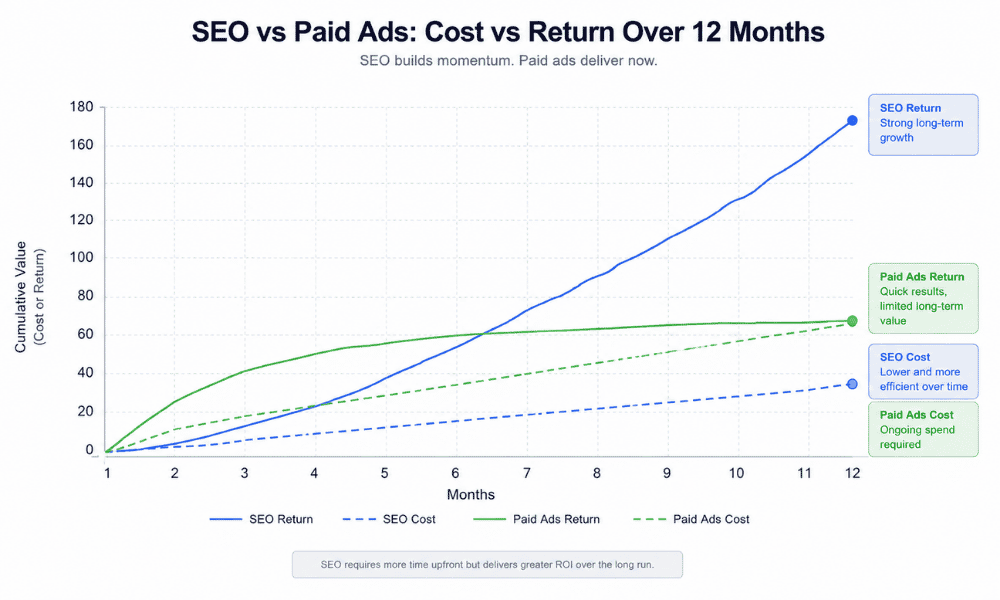
But here’s the practical framing. If you’re planning to be in business for more than a year, which most companies are, the ROI of SEO eventually outpaces paid channels because your cost per acquisition keeps dropping the longer your content ranks. A landing page that took three months to rank and now brings in 50 organic leads a month is effectively free traffic at that point. Compare that to running ads for the same 50 leads every single month indefinitely.
ROI of SEO vs Paid Advertising
It’s worth comparing these two directly, since they’re the channels business owners most often weigh against each other.
Paid advertising wins on speed. You can launch a campaign today and see traffic tomorrow. It’s also easier to measure in the short term since every click and conversion is tracked in real time.
SEO wins on durability and cost efficiency over time. Once you’re ranking, you’re not paying per click, and your traffic doesn’t vanish the second your budget runs out. This is the core reason the return on SEO investment tends to look better the further out you measure it. A 6-month snapshot might favor paid ads. An 18-month snapshot almost always favors SEO for businesses that stick with it.
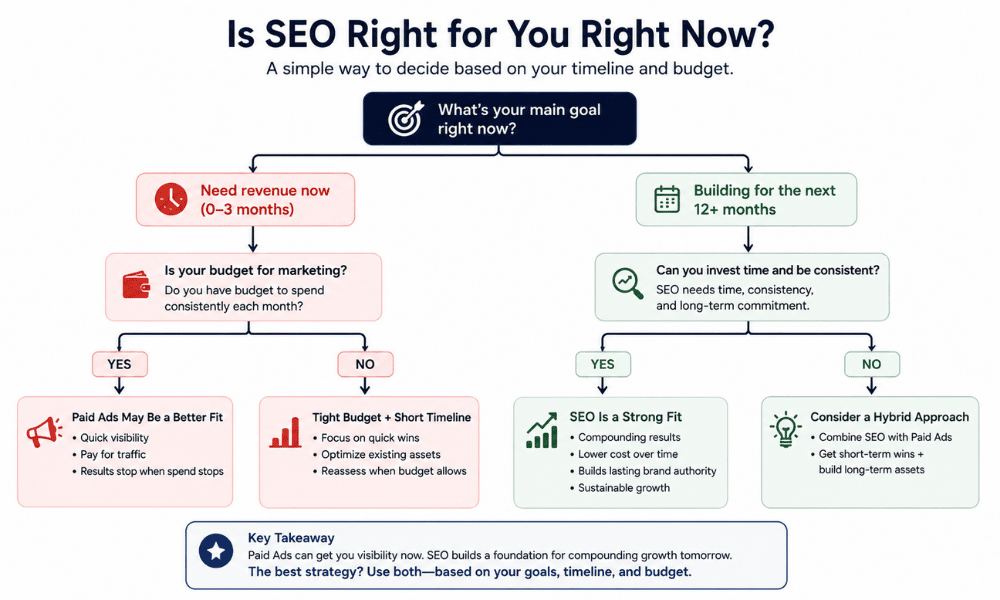
The smartest approach for most companies isn’t choosing one over the other. It’s using paid ads for immediate revenue while SEO builds in the background, then gradually shifting budget as organic traffic starts carrying more of the load.
Factors That Affect Your SEO ROI
Not every business gets the same return, and that’s important to understand before committing budget.
Industry competitiveness plays a huge role. A local plumbing company will typically see faster, cheaper returns than a SaaS company competing for terms that enterprise brands have long dominated.
Content quality matters more in 2026 than ever, partly because AI search tools reward genuinely useful, well-structured content and tend to ignore thin or generic pages.
The technical health of your website can quietly sabotage even great content. A slow, poorly structured site will underperform no matter how good the writing is.
Consistency is probably the most underrated factor. Businesses that publish and optimize consistently for a year will almost always outperform those that do a big push for two months and then go quiet.
A Real-World Example
A regional HVAC company, we’ll call a mid-size service business, invested $3,000 a month in SEO starting in early 2025. For the first four months, rankings barely moved. By month seven, they were ranking on page one for a dozen local service terms. By month twelve, organic traffic accounted for 40 percent of their new customer bookings, at a cost per lead roughly one-third of what they were paying through Google Ads.
Over that year, they spent $36,000 on SEO and generated an estimated $210,000 in attributable revenue from organic leads. That’s a return of well over 400 percent, and unlike their ad spend, most of that ranking power is still working for them without additional cost. This is a fairly typical pattern for local and regional businesses that stay committed through the slow early months.
Is Investing in SEO Worth It in 2026?
For most businesses planning to operate for more than a year, yes. The ROI of SEO in 2026 holds up well against rising ad costs, and the shift toward AI-powered search hasn’t eliminated organic visibility; it’s just changed what visibility looks like. Brands that show up in both traditional listings and AI-generated answers are capturing more attention than ever, and that visibility compounds over time in a way paid channels can’t replicate.
The caveat is that SEO isn’t a fit for businesses needing revenue this month, or ones unwilling to commit to at least six to twelve months of consistent effort. If that’s your situation, paid advertising should carry the short-term load while SEO builds underneath it.
Key Takeaways
- The ROI of SEO is measured by comparing the value of organic traffic against total SEO spend, and typically ranges from 200 to 400 percent for businesses that stay consistent for a year or more
- Returns usually take four to six months to appear and closer to a year to fully mature
- SEO costs less over time than paid ads because rankings don’t disappear when spending pauses
- AI-driven search results have changed how visibility is measured, but haven’t reduced the value of a strong organic presence
- Content quality, technical health, industry competitiveness, and consistency are the biggest factors influencing your SEO ROI
- For businesses planning to operate long-term, the ROI of SEO in 2026 remains one of the more reliable investments in a marketing budget