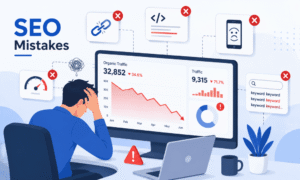
If you have searched your own business name or a service you offer and come up empty on the first page, you are not alone. Thousands of business owners type some version of “why is my business not ranking on Google” into a search bar every single day, usually right after a slow month or a website relaunch that did not go the way they hoped.
The frustrating part is that not ranking on Google rarely comes down to one single mistake. It is usually a mix of small technical issues, thin content, and missed local signals that quietly add up. The good news is that once you know what to look for, most of these problems are fixable without a total website overhaul.
This article walks through the most common reasons your business is not ranking on Google, how to diagnose which ones apply to you, and the exact steps to start climbing the results page again.
Common Reasons Your Business Is Not Ranking on Google
Before you can fix anything, it helps to understand where the breakdown usually happens. Here are the reasons we see most often despite a business owner putting in real effort.
1. Technical SEO Problems Are Blocking Google
Search engines cannot rank what they cannot properly read. Broken internal links, missing sitemaps, slow-loading pages, and pages accidentally blocked in your robots.txt file are all common culprits. If Google’s crawlers cannot access or understand your pages, your business is not ranking on Google simply because it is not being indexed correctly in the first place.
A quick way to check this is to search “site:yourdomain.com” on Google. If far fewer pages show up than you expect, or your most important pages are missing entirely, you have found part of your answer. Fixing this alone will not guarantee a top spot, but it removes the ceiling that was stopping your other work from paying off.
2. Your Content Is Too Thin or Too Generic
Google rewards pages that genuinely answer a searcher’s question. If your service pages are a paragraph or two of generic marketing copy, they are competing against detailed, specific content from other businesses in your space. This is one of the most overlooked reasons a business is not ranking on Google, especially in competitive local markets where every plumber, dentist, or agency is fighting for the same handful of keywords.
Thin content is not just about word count either. A 2,000-word page stuffed with fluff can perform worse than a focused 800-word page that actually solves the reader’s problem. Google’s systems are increasingly good at distinguishing between a page written to satisfy a searcher and one written mainly to satisfy a keyword quota, and the second type rarely holds a top position for long.
3. Missing or Incomplete Local SEO Signals
For local businesses, this is often the single biggest factor. An unclaimed or incomplete Google Business Profile, an inconsistent business name, address, and phone number across directories, and a lack of local reviews all send weak signals to Google. If you serve a specific city or region, this is usually the first place to look, since local pack results depend heavily on these signals rather than on traditional organic ranking factors alone.
Inconsistent citations are especially sneaky. If your business is listed as “123 Main St” in one directory and “123 Main Street, Suite B” in another, Google has to work harder to confirm that these are the same business, and that friction can quietly hurt your local visibility.
4. You Do Not Have Enough Quality Backlinks
Backlinks still act as a trust signal. If competitors have dozens of relevant sites linking back to them and you have almost none, Google has less reason to trust your site as an authority. This does not mean you need hundreds of links overnight. A handful of relevant, earned links from local news sites, industry directories, or partner businesses can make a real difference, especially in industries where most competitors have put little effort into link building.
5. Poor Site Speed and Mobile Experience
More than half of all searches happen on mobile devices. If your site takes more than a few seconds to load, or the layout breaks on a phone screen, visitors bounce quickly, and Google notices that pattern. A slow, clunky mobile experience is a quiet but common culprit even when the content itself is solid, and it is one of the easier problems to test for yourself in under five minutes.
6. Targeting the Wrong Keywords Entirely
Sometimes the issue is not visibility at all, but targeting. If you are optimizing for terms with almost no search volume, or terms so competitive that a small local business has no realistic shot at ranking, you can do everything else right and still see no movement. Matching your content to what people are actually typing into Google matters just as much as the content’s quality.
How to Diagnose Why You’re Not Ranking on Google
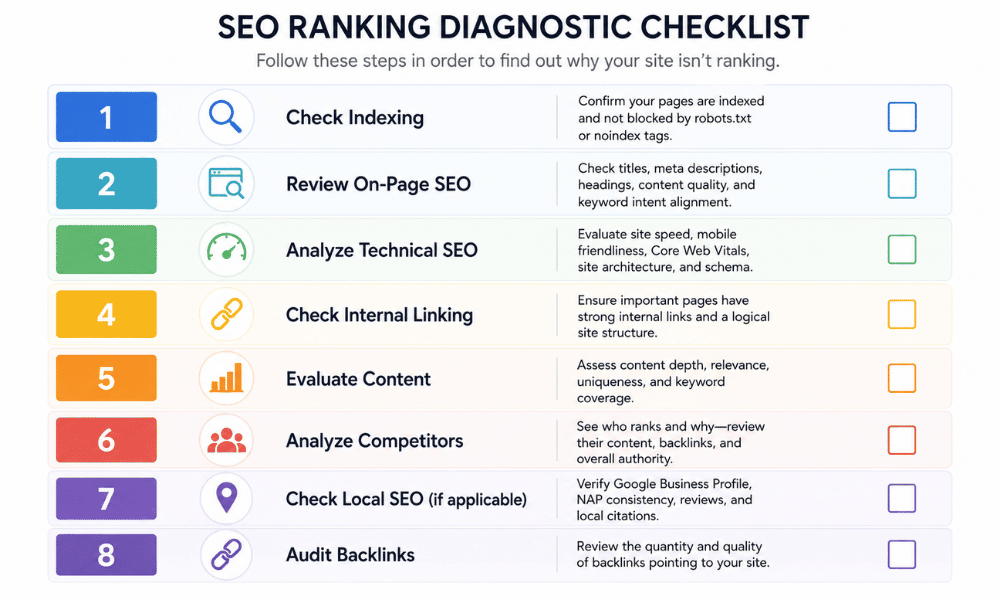
Rather than guessing, run through this quick diagnostic checklist:
- Check indexing: Search “site:yourdomain.com” to confirm your important pages are indexed.
- Run a speed test: Use a free tool like Google PageSpeed Insights to check load times on mobile and desktop.
- Audit your Google Business Profile: Confirm it is claimed, fully filled out, and has recent reviews.
- Review your top pages: Read your homepage and service pages as if you were a customer. Do they actually answer questions, or just describe your company?
- Check your backlink profile: Free tools like Ubersuggest or Ahrefs’ free backlink checker will show roughly how many sites link to you compared to competitors.
Most struggling businesses will find at least two or three of these issues overlapping, which is exactly why isolated fixes, like just adding blog posts, often do not move the needle on their own.
Step-by-Step Fixes to Improve Your Rankings
Fix Your Technical Foundation First
Submit an updated sitemap via Google Search Console, fix any broken links flagged in the coverage report, and ensure important pages are not accidentally set to “noindex.” This is unglamorous work, but it is the foundation on which everything else builds.
Rewrite Thin Pages With Real Substance
Take your top three service pages and rewrite them to actually answer the questions a customer would have before making a purchase. Include specifics: pricing ranges, timelines, what is included, and real examples of past work. This single change is often enough on its own to start reversing a “not ranking on Google” situation for competitive commercial terms.
Fully Build Out Your Google Business Profile
Add photos, service categories, business hours, and respond to every review, positive or negative. Ask happy customers directly for a review right after a job is completed. Local ranking factors respond strongly and relatively quickly to this kind of consistent activity.
Earn a Handful of Relevant Backlinks
Reach out to local business associations, sponsor a community event, or offer a quote to a local journalist covering your industry. A few genuinely relevant links will do more than a large batch of low-quality ones.
Improve Page Speed and Mobile Layout
Compress large images, remove unused plugins or scripts, and test your site on an actual phone, not just your desktop browser. Small improvements here often produce noticeable ranking movement within a few weeks.
Match Content to Real Search Intent
Use a free keyword tool to see what people are actually searching for in your industry and area, then build or adjust pages around those specific terms rather than guessing.
When to Expect Results After Making These Changes
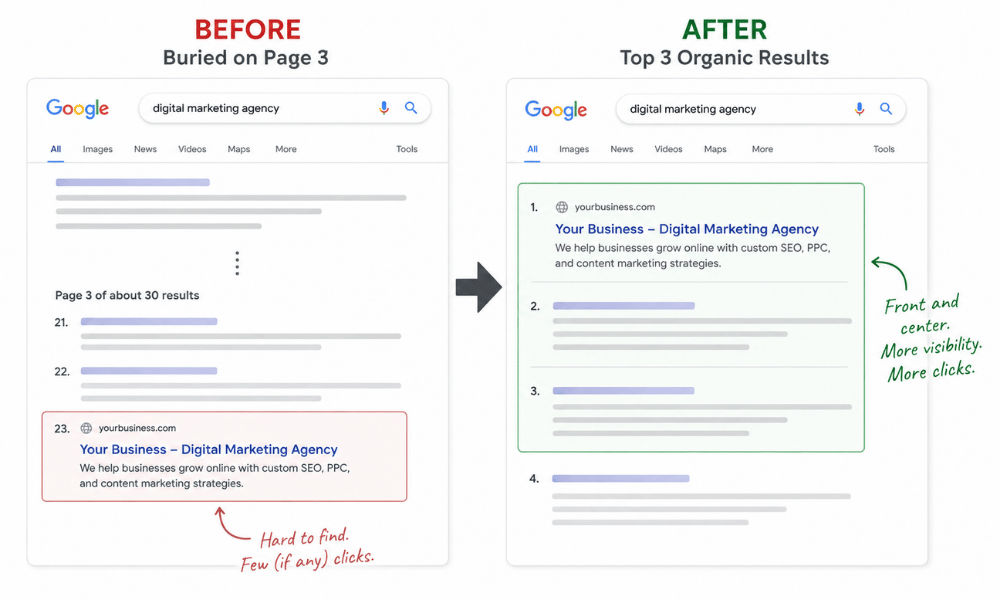
Technical fixes and Google Business Profile improvements can show movement within two to four weeks. Content and backlink changes typically take longer, often six to twelve weeks, since Google needs time to recrawl, re-evaluate, and build trust in the new signals. If your business is not ranking on Google after a full quarter of consistent effort across all these areas, that is usually a sign it is worth getting a second set of eyes on the strategy.
A Quick Word on Patience and Consistency
One mistake we see constantly is businesses making one or two changes, checking rankings three days later, and giving up when nothing has moved yet. Google’s algorithm needs to recrawl your pages, reassess your signals, and compare you against everyone else competing for the same terms. That process takes time, even when every fix you made was the right one.
The businesses that recover fastest are usually the ones that treat this as an ongoing habit rather than a one-time project. A monthly check of your Google Business Profile, a fresh page or two of genuinely useful content each quarter, and periodic outreach for a link here and there will compound far more effectively than a single intense sprint followed by months of neglect.
When to Bring in Professional Help
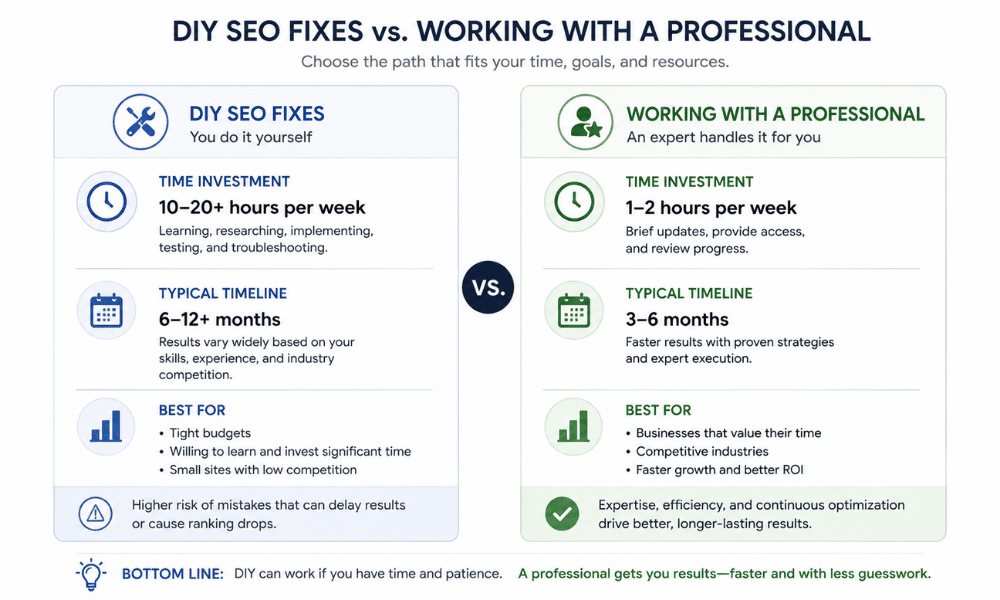
Doing the basics yourself will solve the problem for many small businesses. But if you are in a competitive market, juggling limited time, or have already tried the steps above without much progress, working with an SEO professional or agency can save you months of trial and error. A good practitioner will run a full audit, prioritize the fixes with the biggest impact, and track progress against real ranking and traffic data rather than vanity metrics.
Key Takeaways
- A business is not ranking on Google for a mix of reasons, rarely just one, so a full diagnostic beats guessing at a single fix.
- Technical issues like poor indexing and slow load times quietly block otherwise good content from ranking.
- Thin, generic pages lose to detailed, specific content that actually answers a customer’s question.
- Local businesses should prioritize a complete, active Google Business Profile alongside consistent NAP details across the web.
- A small number of relevant backlinks outperforms a large number of low-quality ones.
- Results take time: expect a few weeks for technical and local fixes, and two to three months for content and backlink work to fully show up in rankings.
- If your business is still not ranking on Google after consistent effort, a professional audit can identify what is being missed.